
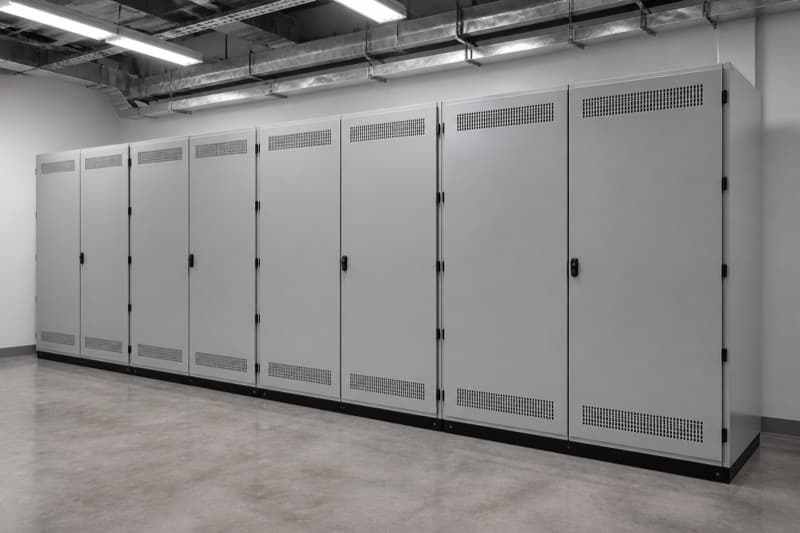
Air Circuit Breakers (ACB)
An air circuit breaker (ACB) is the main protection and switching device at the top of an LV switchgear or main distribution board, rated from around 630A up to 6300A, built to interrupt current in open air rather than a moulded enclosure. NLS Power sources ACBs to IEC 60947-2, with electronic trip units sized to the switchboard's fault level.
An air circuit breaker sits at the incoming point of an LV switchgear lineup or a main distribution board, where the current is highest and the consequence of a protection failure is largest. It interrupts current by drawing the arc out into open air within the breaker chamber rather than sealing it inside a moulded case, which is what lets ACBs scale to the high current ratings, typically 630A to 6300A, that a moulded case breaker can't reach cost-effectively.
Electronic trip units are now standard on ACBs rather than an option, giving LSIG protection: long-time (overload), short-time (short circuit with a deliberate delay for coordination), instantaneous (direct short circuit), and ground fault, each independently adjustable. That adjustability is what makes protection coordination between an ACB at the switchgear and MCCBs further downstream possible; without it, an upstream breaker either trips before it should on a downstream fault, or fails to trip fast enough on its own.
Breaking capacity, expressed as Icu (ultimate) and Ics (service) in kA, has to match or exceed the fault current the system study calculates at that point in the network, and this is one of the few numbers on a distribution board that genuinely cannot be approximated: a breaker rated below the actual fault level can fail to clear a fault safely, which is a life safety issue, not a specification technicality.
Drawout ACBs, mounted on a chassis that racks in and out of the switchboard, let the breaker be withdrawn for testing or maintenance without disturbing the busbar behind it, and most Saudi hospital, data centre and process plant specifications call for drawout construction on incoming ACBs for exactly that reason. Fixed-mount ACBs remain common on smaller or less maintenance-critical boards.
NLS Power sources ACBs to IEC 60947-2, fixed or drawout, with electronic trip units and optional Modbus communication for remote monitoring. Quoting works from the required current rating, the fault level (Icu/Ics) from the system study, and whether drawout construction is specified; NLS Power returns pricing in USD once those inputs are confirmed.
Specifications
- ✓To IEC 60947-2, low voltage air circuit breaker standard
- ✓Current ratings typically 630A to 6300A frame size
- ✓Electronic trip units with LSIG protection (long-time, short-time, instantaneous, ground fault)
- ✓Breaking capacity expressed as Icu (ultimate) and Ics (service) in kA, matched to system fault study
- ✓Fixed or drawout (withdrawable) mounting, drawout specified where live maintenance access is required
- ✓Optional Modbus RTU/TCP communication for remote status and trip monitoring
Frequently Asked Questions
What's the difference between an ACB and an MCCB?+
ACBs cover the higher current range, roughly 630A and up, and interrupt current in open air with fully adjustable electronic trip settings. MCCBs cover lower currents, up to around 2500A, in a sealed moulded case, usually at lower cost per unit.
Who supplies ACBs sized to a project's fault level in Saudi Arabia?+
NLS Power sources ACBs to IEC 60947-2, matching Icu and Ics breaking capacity to the fault current calculated in the project's system study, in fixed or drawout construction.
Why does an incoming ACB need to be drawout type?+
Drawout construction lets the breaker be withdrawn for testing or maintenance without shutting down or exposing the busbar behind it, which is why hospital, data centre and process plant specifications typically require it on the main incoming device.
Who supplies Air Circuit Breakers (ACB) in Saudi Arabia?+
NLS Power (Northlane Solutions Company) supplies Air Circuit Breakers (ACB) across Saudi Arabia, including Riyadh, Jeddah, Dammam and Jubail. Send your specification and quantities to info@nlspower.com or info@northlanesolution.com for a quotation.