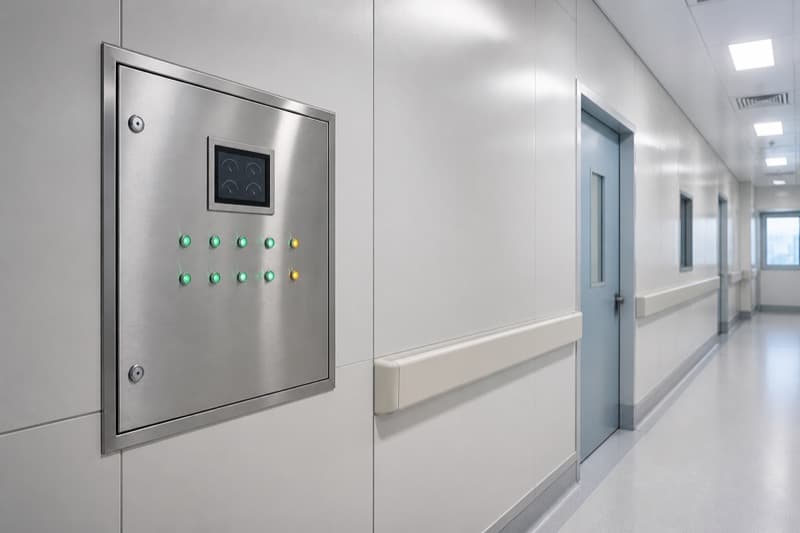
NFPA 99 isolation panels supply ungrounded power to wet procedure locations such as operating rooms, cath labs, and delivery rooms, so a single fault to ground doesn't create a shock or spark hazard. NLS sources and supplies isolation panels built to NFPA 99 Category 1 and UL 1047 for Saudi MOH and private hospital projects.
A line isolation monitor (LIM) continuously watches an ungrounded medical power system for total hazard current and alarms before a second fault can create a shock risk in an operating room or other Category 1 space. NLS sources LIM units built to NFPA 99 alarm thresholds for Saudi hospital electrical infrastructure projects.
An operating theatre panel packages the isolation transformer, line isolation monitor, and branch circuit breakers for a specific OR into one panel schedule, with a remote LIM display mounted at the theatre entrance. NLS sources theatre panels sized to the room's isolated branch circuit count for Saudi MOH and private hospital operating suites.
A medical isolation transformer is the dry-type, low-leakage-capacitance transformer inside an NFPA 99 isolation panel that creates the ungrounded secondary circuit for a wet procedure location. NLS sources medical isolation transformers from 1kVA to 25kVA, built to UL 1047 and IEC 61558-2-15, for Saudi hospital electrical projects.
An equipotential bonding system connects every exposed conductive surface in a Category 1 space, bed frames, equipment rails, plumbing, to a single reference point with low-impedance conductors, keeping any potential difference in the room low enough to protect a patient with a direct cardiac connection. NLS sources bonding components for Saudi hospital wet procedure locations.
Medical-grade (hospital-grade) socket outlets are built to a higher retention and pull-out force standard than a standard outlet, so a plug stays seated through the accidental tugs common in a patient care area. NLS sources hospital-grade outlets, including isolated-circuit versions for Category 1 rooms, for Saudi MOH and private hospital electrical fit-outs.
A theatre control panel is the single interface mounted at the OR entrance combining the LIM display, medical gas area alarm, and surgical lighting controls, so staff read isolated power status and gas line pressure from one fascia. NLS sources theatre control panels built to NFPA 99 Chapter 5 gas alarm requirements for Saudi hospital operating suites.
An online double-conversion UPS rectifies incoming AC to DC and inverts it back to AC continuously, so the output is fully regenerated and isolated from input sags, surges, and frequency drift, with zero transfer time to battery. NLS sources double-conversion UPS units classified VFI under IEC 62040-3 for Saudi hospital essential branches and data centre loads.
A modular UPS builds capacity from hot-swappable power modules, typically 25-100kW blocks, inside one frame, so N+1 redundancy comes from adding one extra module rather than a second full UPS, and a failed module gets replaced live without dropping the load. NLS sources modular UPS platforms for Saudi data centre N+1 and phased-growth deployments.
An industrial UPS is a ruggedized double-conversion unit built for plant environments: wider input voltage tolerance, conformal-coated boards, and higher-rated enclosures for dust and humidity. It protects PLC, DCS, and instrumentation loads where a momentary outage can trip an entire production line. NLS sources industrial UPS units for Saudi process plant and industrial facility power backup.
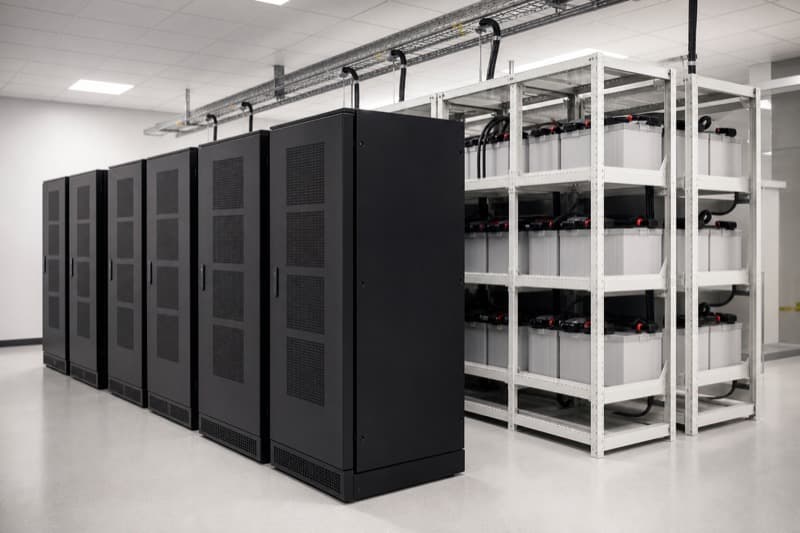
A UPS battery bank is a string of VRLA batteries sized to the UPS DC bus voltage, rated for a defined design life at a 20-25°C reference temperature. Every 8-10°C above that reference roughly halves service life, so battery room cooling matters in Saudi ambient conditions. NLS sources VRLA battery strings sized to project autonomy requirements.
Lithium (LFP) UPS battery cabinets replace VRLA strings with roughly 60-70% less footprint and weight for the same runtime, wider ambient tolerance, and thousands more charge cycles over their service life. Each cabinet carries its own battery management system reporting cell health. NLS sources LFP battery cabinets built to IEC 62619 for Saudi hospital and data centre UPS installations.
A battery monitoring system tracks per-string or per-cell voltage, internal resistance, and temperature on a UPS battery bank, flagging a weakening cell before a runtime test would reveal it. This matters in Saudi battery rooms, where uneven heat exposure ages cells within the same string at different rates. NLS sources monitoring platforms for VRLA and lithium UPS banks.
A static transfer switch (STS) uses solid-state thyristors to move a load between two independent power sources, typically two separate UPS outputs in a 2N system, within a quarter cycle, fast enough that connected equipment never sees the transfer. NLS sources STS units classified under IEC 62310-3 for Saudi data centre 2N architectures and hospital essential branches.
A maintenance bypass panel lets a UPS be fully isolated for internal service, a battery swap, or a firmware update while the load keeps running through an alternate bypass path, with a make-before-break switching sequence that never drops the connected load. NLS sources bypass panels sized to the UPS and load schedule for Saudi hospital and data centre installations.
A DC power system pairs rectifier modules with a battery string to feed 24V, 48V, or 110/220V DC loads directly, telecom racks, SCADA panels, and substation switchgear tripping supplies, without an inverter stage. NLS sources DC power plants with N+1 rectifier redundancy for Saudi substation, telecom, and industrial control room installations.
An industrial inverter converts DC to AC for sustained duty, motor drives, process control loads, and battery or solar-tied backup, as distinct from a UPS's short-duration ride-through role. NLS sources industrial inverters built to IEC 62109 or IEC 61800 series requirements depending on the application, as a supply capability across DC-to-AC conversion needs in Saudi industrial and infrastructure projects.
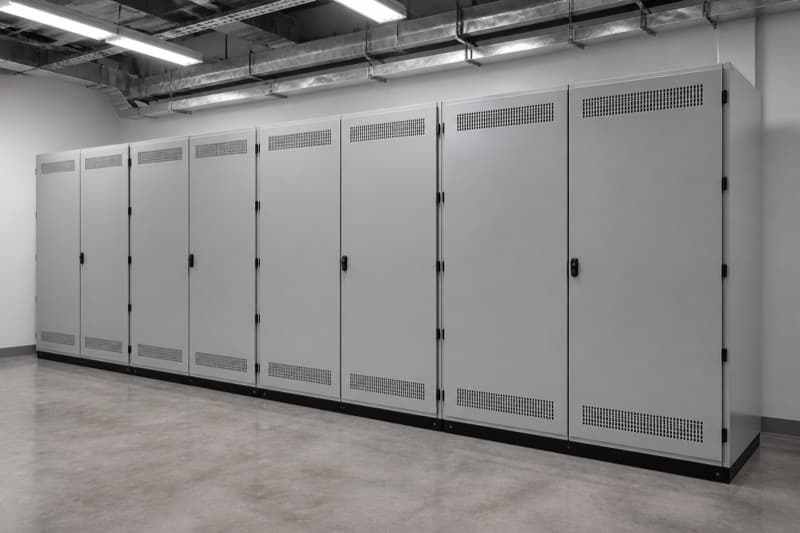
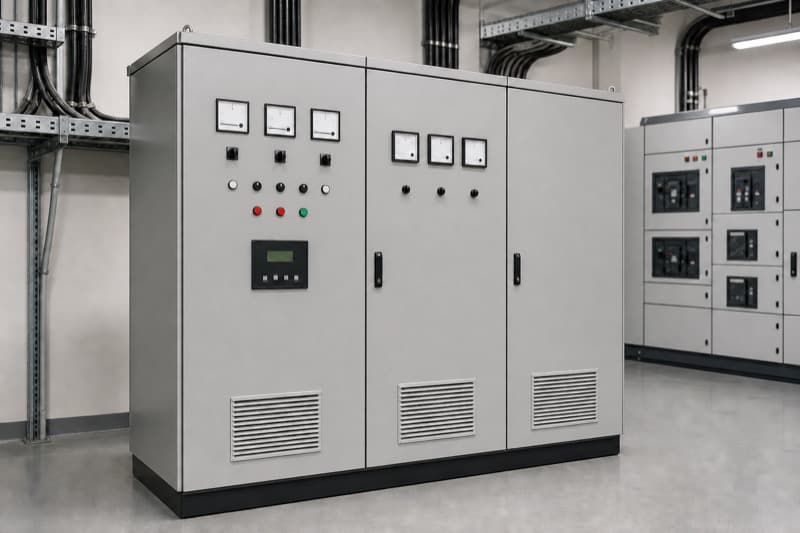
LV switchgear is the factory-built assembly of circuit breakers, busbars and protection devices that distributes power at 400/415V, the standard low voltage level on Saudi projects. NLS Power sources LV switchgear built to IEC 61439-1/2 type tested designs, sized to the short circuit rating and form of separation the project's system study calls for.
MV switchgear switches and protects power at medium voltage, typically 13.8kV or 33kV on SEC-fed Saudi sites, ahead of the step-down transformer that feeds the LV board. NLS Power sources metal-enclosed MV switchgear built to IEC 62271-200, vacuum circuit breaker technology, and internal arc classification for substation and plant rooms.
A motor control center groups the starters, contactors and protection for every motor on a plant into one factory-built assembly instead of scattered local panels. NLS Power sources MCCs built to IEC 61439-2, with fixed or withdrawable starter modules, sized for pumping stations, HVAC plant rooms and process areas on Saudi industrial and utility projects.
A main distribution board (MDB) takes power from the LV switchgear or transformer and splits it into the large feeders that run to sub distribution boards, MCCs and major equipment across a building or plant. NLS Power sources MDBs built to IEC 61439-1/2, with breaking capacity and busbar rating matched to the site's fault level.
A sub distribution board (SDB) is the final panel between the main distribution board and the circuits feeding lighting, small power and local equipment on a floor or in a room. NLS Power sources SDBs built to IEC 61439-3, sized to the final circuit schedule and the form of separation a project's electrical spec calls for.
Busway, or busduct, is a factory-built enclosed conductor system that replaces cable and tray for carrying large currents through building risers and long industrial runs, with tap-off points that let a load be added without pulling new cable. NLS Power sources busway built to IEC 61439-6, rated from 250A up to 6300A, for towers, data centres and plants where load will change.
An air circuit breaker (ACB) is the main protection and switching device at the top of an LV switchgear or main distribution board, rated from around 630A up to 6300A, built to interrupt current in open air rather than a moulded enclosure. NLS Power sources ACBs to IEC 60947-2, with electronic trip units sized to the switchboard's fault level.
A moulded case circuit breaker (MCCB) protects feeders and equipment from around 16A up to roughly 2500A inside a sealed insulated case, sitting between an ACB upstream and MCBs on final circuits downstream. NLS Power sources MCCBs to IEC 60947-2, with thermal-magnetic or electronic trip units, sized to each feeder's load and fault current.
Panel meters read and display voltage, current, power, energy and power quality data on a distribution board, ranging from a simple analogue ammeter to a multifunction meter feeding a building management system. NLS Power sources panel meters to IEC 61557 and IEC 62053 accuracy classes, with Modbus communication for sub-metering and tenant billing on Saudi commercial and industrial projects.
A current transformer (CT) steps down a high primary current to a small, standard secondary signal, typically 5A or 1A, that a meter or protection relay can safely read. NLS Power sources CTs to IEC 61869-2, in metering and protection accuracy classes, sized to the busbar or cable current a project's switchboard and metering schedule specifies.
Cable trays and ladders are the structural support systems that carry power and control cables across a plant, building riser or process area, sized by load class and material to the number and weight of cables they'll actually carry. NLS Power sources galvanized and stainless steel trays and ladders to IEC 61537, matched to Saudi outdoor, corrosive and indoor routing conditions.
Earthing gives fault current a safe path to ground and holds equipment at a safe touch voltage; lightning protection intercepts a direct strike and routes it to earth before it reaches the structure. NLS Power sources earthing electrodes, conductors and surge protection devices to IEC 62305 and IEC 60364-5-54, sized to a project's soil resistivity and risk level.
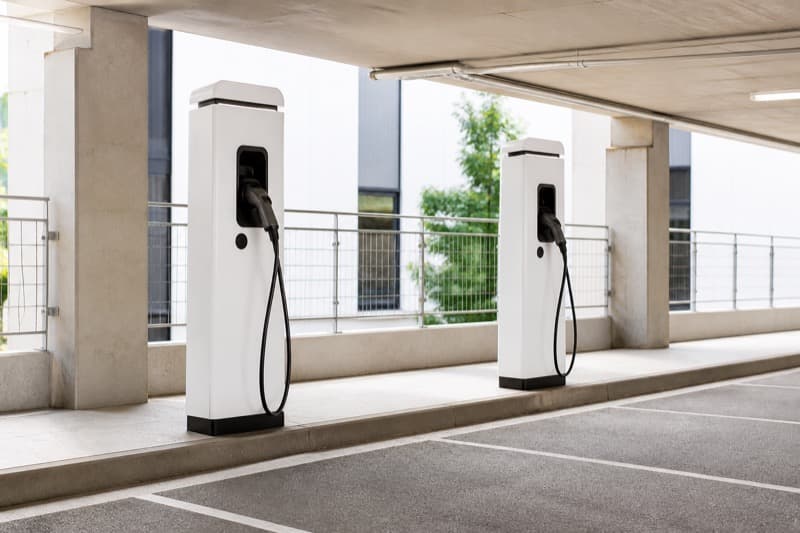
AC wallbox chargers deliver 7 to 22kW of alternating current through an IEC 62196 Type 2 connector, sized for vehicles that sit parked for hours rather than minutes. NLS Power sources and supplies AC wallboxes for offices, hotels, residential compounds and long-stay parking across Saudi Arabia, specified with the load management a site's incoming supply can actually support.
DC fast chargers convert AC to DC inside the unit and feed the vehicle battery directly through a CCS2 connector, cutting charge time to 20 to 60 minutes instead of hours. NLS Power sources and supplies DC fast chargers from 30kW to 180kW for retail, highway and fleet-turnaround sites across Saudi Arabia, sized to the site's available electrical supply.
Ultra-fast charging stations push 180kW to 400kW per connector through a CCS2 interface, cutting a meaningful charge to 10 to 20 minutes for compatible vehicles. NLS Power sources and supplies ultra-fast charging hubs for highway corridors and high-throughput commercial sites in Saudi Arabia, where the grid connection sets the real project cost more than the charger itself.
EV charging load management shares a site's fixed electrical supply dynamically across whichever chargers are plugged in, rather than sizing for every charger at full power together. NLS Power sources and supplies load management controllers for wallbox and DC installs across Saudi Arabia, usually the difference between fitting EV charging into an existing supply and paying for an SEC upgrade.
EV charging management software runs on the OCPP protocol to monitor, control and bill charge points remotely, from a single wallbox to a multi-site network, independent of hardware brand. NLS Power sources and supplies OCPP-compliant back-end platforms alongside its charging hardware for Saudi projects that need remote monitoring, access control or usage billing.
EV charger cable assemblies are the tethered charging cable and connector, IEC 62196 Type 2 for AC or CCS2 for DC, engineered for the flex cycles, current rating and outdoor exposure a public charge point sees over years of daily use. NLS Power sources and supplies replacement and OEM cable assemblies for AC and DC chargers installed across Saudi Arabia.
A fleet charging depot is a purpose-built site where a company's own vehicles charge overnight or between shifts, combining multiple AC or DC chargers, load management and often a dedicated MV supply for simultaneous charging. NLS Power sources and supplies fleet depot charging equipment across Saudi Arabia, scoped to the vehicle count, dwell time and route schedule the operator runs.
Solar EV charging pairs a rooftop or carport PV array with charge points, either offsetting grid draw during daylight hours or, with battery storage added, extending that offset into the evening. NLS Power sources and supplies solar-integrated EV charging systems for Saudi Arabia's high solar-irradiance climate, sized against the site's parking footprint and typical charging demand profile.
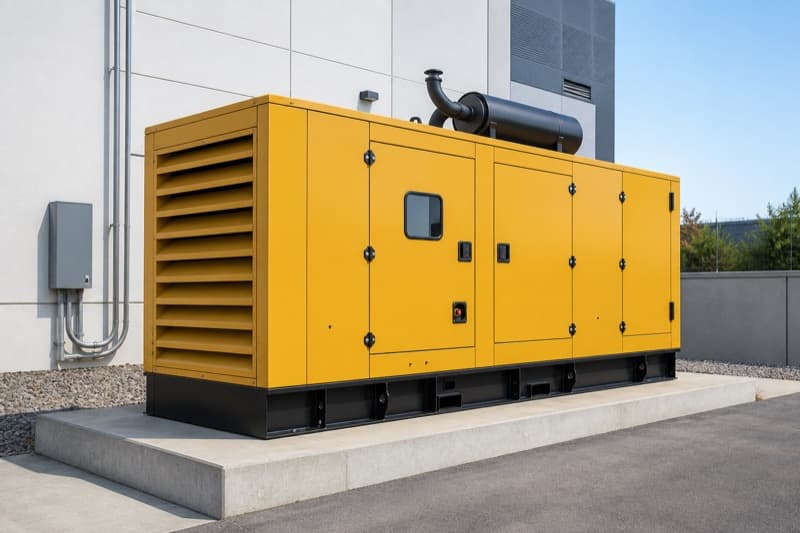
Industrial generator sets provide essential power for demanding operations, from critical backup to continuous prime power. NLS Power supplies a wide range of reliable generator solutions tailored for sectors like oil and gas, manufacturing, and data centers, ensuring your operations remain powered efficiently and safely.
Diesel generators provide backup or continuous electrical power through a diesel engine driving an AC alternator, sized in kVA and rated to ISO 8528 as prime or standby duty. NLS sources diesel generator sets from 20kVA to 2500kVA for contractors, hospitals, and industrial sites across Saudi Arabia, priced in USD with ambient-derated output for local conditions.
Gas generators burn natural gas or LPG instead of diesel to drive an AC alternator, suited to continuous or prime duty wherever a gas supply already reaches the site. NLS sources gas generator sets from 20kVA to 2000kVA for industrial and commercial projects across Saudi Arabia, rated to ISO 8528, with lower fuel-storage overhead than an equivalent diesel set.
Portable generators are small, mobile diesel or petrol units that supply power on site without a fixed installation, typically single or three phase up to around 20kVA. NLS sources portable generator sets for construction sites, temporary events, and remote maintenance work across Saudi Arabia, priced in USD, with output sized to the load a site actually needs.
An automatic transfer switch (ATS) detects a utility power failure and switches the electrical load to a standby generator without manual intervention, then switches back once utility power is stable. NLS sources ATS panels from 100A to 4000A for hospital, commercial, and industrial projects across Saudi Arabia, built to IEC 60947-6-1 and sized to NFPA 110 transfer-time requirements where emergency power applies.
A synchronizing panel matches voltage, frequency, and phase angle between two or more generators, or between a generator and the utility grid, before closing the breaker to run them together. NLS sources synchronizing panels for multi-set generator plants and N+1 redundant power systems across Saudi Arabia, sized to the number of sets and paralleling scheme a project needs.
A generator control panel monitors and manages a genset's engine and alternator, handling auto-start on utility failure, run-time protection, and shutdown on fault conditions like low oil pressure or overspeed. NLS sources generator control panels for new installations and control-panel retrofits across Saudi Arabia, with remote monitoring and BMS integration available where a project specifies it.
Fuel tanks and day tanks store diesel for a standby generator, either as bulk storage sized for a project's full autonomy requirement or as a smaller day tank feeding the engine directly. NLS sources bunded bulk tanks and day tanks built to NFPA 30/31 for hospital, industrial, and commercial standby power projects across Saudi Arabia.
A generator acoustic enclosure wraps a genset in sound-attenuating panels to bring noise down to a level a site's noise limit allows, typically expressed in dB(A) measured at a set distance from the unit. NLS sources acoustic enclosures for diesel and gas generator sets across Saudi Arabia, sized to meet the noise limit a project's location and nearby occupied buildings require.
A load bank applies an artificial electrical load to a generator so it can be tested at or near its rated output without connecting to the site's actual electrical load. NLS sources resistive and reactive load banks for genset commissioning, acceptance testing, and NFPA 110 monthly load testing on projects across Saudi Arabia.
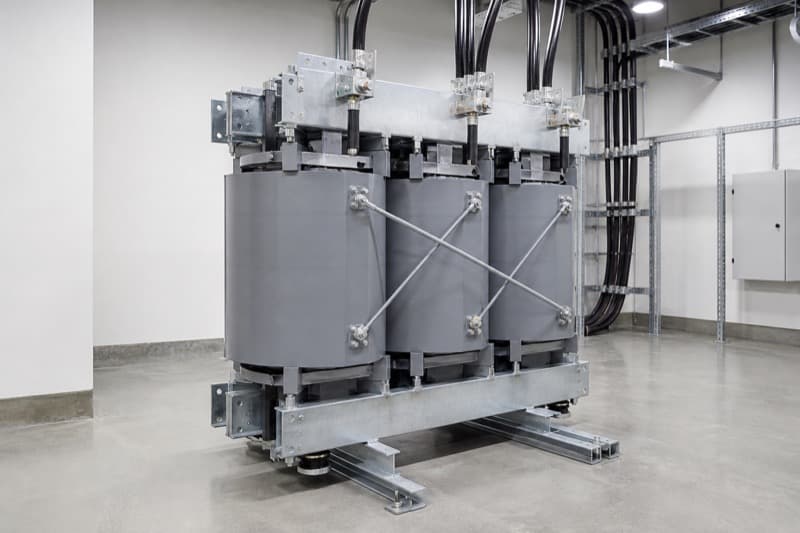
Dry-type transformers use air or resin-insulated windings instead of oil, which makes them the standard choice for basements, hospitals, high-rise risers and any indoor room where fire load and oil containment are a concern. NLS Power supplies dry-type units built to IEC 60076-11, in AN and AF cooling classes, sized to the vector group and rating an SEC connection requires.
Oil-immersed transformers use mineral oil or synthetic ester both to insulate the windings and to carry heat away, which makes them more efficient per kVA than a dry-type unit at the same rating. NLS Power supplies oil-immersed transformers built to IEC 60076, in ONAN and ONAF cooling classes, for outdoor SEC-connected substations across Saudi Arabia.
Cast-resin transformers encapsulate the windings in epoxy resin under vacuum, a dry-type construction that resists moisture and dust without a separate enclosure. NLS Power sources and supplies cast-resin units built to IEC 60076-11 for hospitals, data centres, metro stations and coastal or dusty sites across Saudi Arabia where a conventional dry-type winding would need extra protection.
A package substation combines MV switchgear, a transformer and an LV panel inside one factory-built, weatherproof enclosure, delivered to site as a single tested unit rather than assembled from separate equipment. NLS Power sources and supplies package substations built to IEC 62271-202 for compounds, labor camps, retail and industrial sites across Saudi Arabia, reducing on-site civil and electrical work.
A unit substation assembles MV switchgear, transformer and LV switchboard as coordinated equipment for a building's own electrical room, rather than a free-standing outdoor kiosk. NLS Power sources and supplies unit substations for high-rise towers, hospitals and industrial plants across Saudi Arabia, engineered so protection settings between the MV and LV sides are coordinated before equipment reaches site.
A ring main unit is a compact MV switchgear panel, usually three-way, that loops a medium voltage ring between substations so a fault on one section can be isolated without cutting power to the rest of the loop. NLS Power sources and supplies RMUs built to IEC 62271-200 for compound, industrial park and campus distribution networks across Saudi Arabia.
An auto-transformer shares a single winding between primary and secondary instead of using two fully isolated windings, which makes it smaller, lighter and lower-loss than a two-winding transformer of the same rating for a modest voltage change. NLS Power sources and supplies auto-transformers built to IEC 60076-1 for voltage step and interconnection duty on Saudi transmission and industrial projects.
Transformer protection relays detect internal and external faults, differential, restricted earth fault, overcurrent and temperature, and trip the transformer's circuit breakers before a fault causes structural damage or spreads to the wider network. NLS Power sources and supplies numerical protection relays with IEC 61850 communication for transformers on SEC-connected and industrial substations across Saudi Arabia.
Obstruction lighting marks tall structures, towers, cranes and buildings that penetrate airspace so aircraft can see and avoid them at night and in low visibility. NLS supplies LED low, medium and high intensity obstruction lights built to ICAO Annex 14 and FAA AC 150/5345-43 for GACA-regulated structures across Saudi Arabia, and this is one of the company's core specialisms.
Hazardous area lighting provides safe, reliable illumination in environments where flammable gases, vapors, dusts, or fibers are present. These specialized fixtures are engineered to prevent ignition and ensure operational safety, complying with strict international and local standards. NLS Power supplies a wide range of hazardous area lighting solutions for diverse industrial applications across Saudi Arabia.
Airfield ground lighting (AGL) covers the runway, taxiway, and apron fixtures, edge lights, threshold lights, PAPI approach slope indicators, that guide pilots during taxi, takeoff, and landing in darkness or low visibility. NLS has supplied AGL fixtures built to ICAO Annex 14 and GACA airfield lighting standards for Saudi airbase and heliport projects, a core specialism of the company.
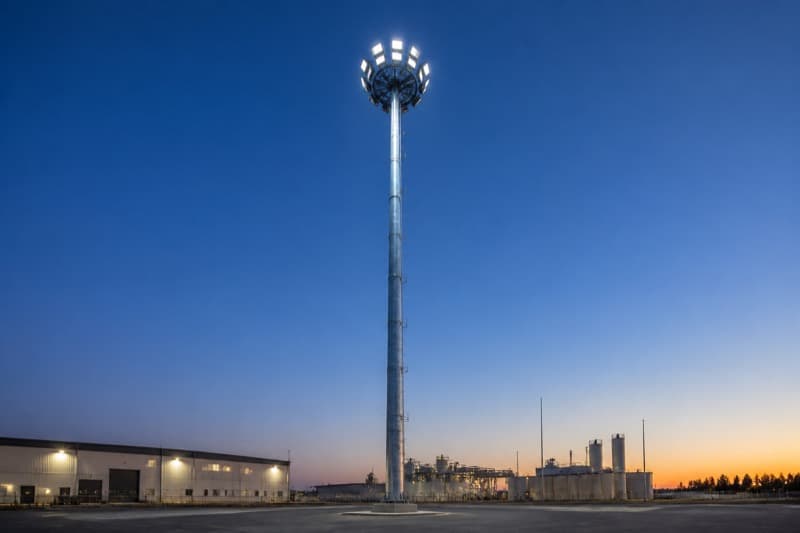
High mast lighting mounts multiple floodlights on a pole from about 15 to 40 meters, on a lowering winch head, to light large open areas, highway interchanges, ports, rail yards, and industrial yards, from a few tall structures instead of many short poles. NLS sources high mast systems built to IEC 60598 and matched to Saudi wind-load requirements.
High bay LED fixtures light warehouses, factories, and workshops with ceiling heights above roughly 6 meters, replacing older metal halide and fluorescent high bay units with a fixture that draws less power and starts instantly. NLS sources high bay LED lighting rated for Saudi ambient heat, built to IEC 60598, for industrial and logistics sites across the Kingdom.
Street lighting fixtures mount on 6 to 12 meter poles to light roads, residential streets, and pedestrian routes to a defined lux and uniformity level, generally LED units now displacing high pressure sodium across new Saudi road projects. NLS sources LED street lighting built to IEC 60598 and photometric classes matched to road category, for contractors and municipal-linked projects across the Kingdom.
Emergency and exit lighting switches on automatically when normal power fails, lighting escape routes and marking exit doors so occupants can leave a building safely. NLS sources self-contained and central-battery emergency luminaires and illuminated exit signs built to IEC 60598-2-22, sized for the escape-route autonomy time a project's fire strategy specifies, for hospital and industrial buildings across Saudi Arabia.
Flood lights throw a wide, directable beam over an open area, a facade, a security perimeter, or a stadium field, from a wall, pole, or ground mount rather than a fixed grid overhead. NLS sources LED flood lights built to IEC 60598 with IP66 housings and glare-control options, for security, facade, and outdoor facility lighting on projects across Saudi Arabia.
Explosion-proof lighting is built and certified to prevent an internal spark or hot surface from igniting a surrounding flammable atmosphere, classified by hazardous zone rather than sold as a generic rugged fixture. NLS sources ATEX and IECEx-certified LED fixtures for Zone 1/2 and Zone 21/22 areas, matched to the gas or dust group a Saudi plant's hazardous area classification specifies.
Lighting control systems switch, dim, and schedule fixtures automatically through protocols like DALI or 0-10V analog dimming, rather than leaving every circuit on a simple manual switch. NLS sources DALI-ready drivers, dimming panels, and occupancy/daylight sensors built to IEC 62386, for facility and street lighting projects across Saudi Arabia looking to cut energy use and centralize control.
Solar street lights combine an LED fixture, solar panel, battery, and controller into a self-contained pole unit that needs no grid connection or trenched cable, suited to roads and paths without nearby power infrastructure. NLS sources and supplies all-in-one and split-type solar street lighting sized for Saudi solar irradiance and summer autonomy needs, as a capability alongside its grid-powered lighting range.
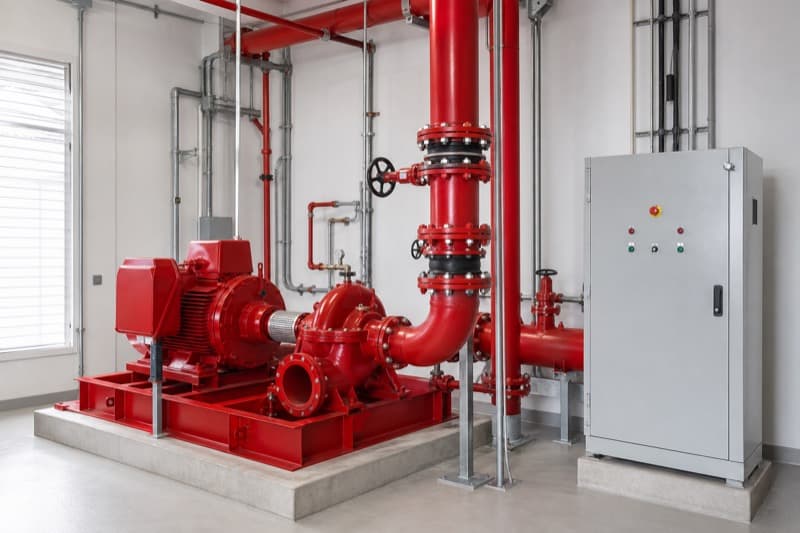
A fire pump raises municipal or tank water pressure to the flow and pressure a sprinkler or hydrant system needs during a fire, sized and tested to NFPA 20. NLS sources electric, diesel, and jockey fire pump sets for hospital and industrial fire protection systems in Saudi Arabia, built for Saudi Civil Defence approval documentation from the outset.
Automatic sprinkler systems detect and suppress a fire directly at its source through heat-activated sprinkler heads on a pressurized pipe network, designed and installed to NFPA 13. NLS sources wet-pipe and dry-pipe sprinkler system components sized to a space's hazard classification, for hospital and industrial buildings across Saudi Arabia where Civil Defence approval requires a compliant design.
A fire alarm control panel receives signals from detectors and manual call points, decides whether a real alarm condition exists, and triggers notification devices and other fire safety equipment, designed and installed to NFPA 72. NLS sources addressable and conventional fire alarm panels for hospital and industrial buildings across Saudi Arabia, scoped for Civil Defence-reviewed system design.
Smoke detectors sense combustion particles in the air before flame or heat becomes significant, giving the earliest practical warning a fire alarm system can provide, installed and spaced to NFPA 72. NLS sources point-type and aspirating smoke detection systems for hospital critical areas, plant rooms, and industrial facilities across Saudi Arabia, matched to the space's airflow and detection-sensitivity requirement.
Clean agent suppression floods a room with a gaseous agent that puts out a fire without leaving residue or damaging electronic equipment, designed and installed to NFPA 2001. NLS sources clean agent systems (FM-200, Novec 1230, and inert gas types) for data centers, electrical rooms, and control rooms across Saudi Arabia, sized to the room's volume and hazard.
Foam suppression systems mix water with a foam concentrate to smother flammable liquid fires that a plain water stream can't put out, designed and installed to NFPA 11. NLS sources AFFF and alcohol-resistant foam concentrate and proportioning equipment for fuel storage, tank farms, and industrial facilities across Saudi Arabia handling flammable or combustible liquids.
Fire hose reels and standpipe cabinets give building occupants and fire crews a manual water supply for first-response firefighting, fed from a standpipe riser sized to NFPA 14. NLS sources hose reel assemblies, standpipe valves, and fire hose cabinets for hospital corridors, industrial buildings, and multi-story projects across Saudi Arabia.
Portable fire extinguishers give occupants a first-response tool for a small fire before it spreads, selected by class (A, B, C, D, K) to match the fuel type present and placed and inspected to NFPA 10. NLS sources dry chemical, CO2, water, foam, and wet chemical extinguishers matched to occupancy hazard, for hospital, commercial, and industrial buildings across Saudi Arabia.
Fire pumps, alarm panels, smoke fans, and sprinkler control circuits need power and signal cable that keeps working during the fire it's meant to fight, built to BS 6387 or IEC 60331 circuit integrity standards rather than standard wiring. NLS sources fire-resistant cable for the circuits feeding hospital and industrial fire protection equipment across Saudi Arabia, matched to the fire strategy's required survival time.
VRF (variable refrigerant flow) systems run one outdoor condensing unit against multiple indoor units, each modulating its own refrigerant flow to match zone load independently. NLS sources VRF systems sized for the Saudi 50°C design ambient, for office towers, hotels, and mixed-use buildings where zone-by-zone control and cooling capacity retention matter more than a single central chiller plant.
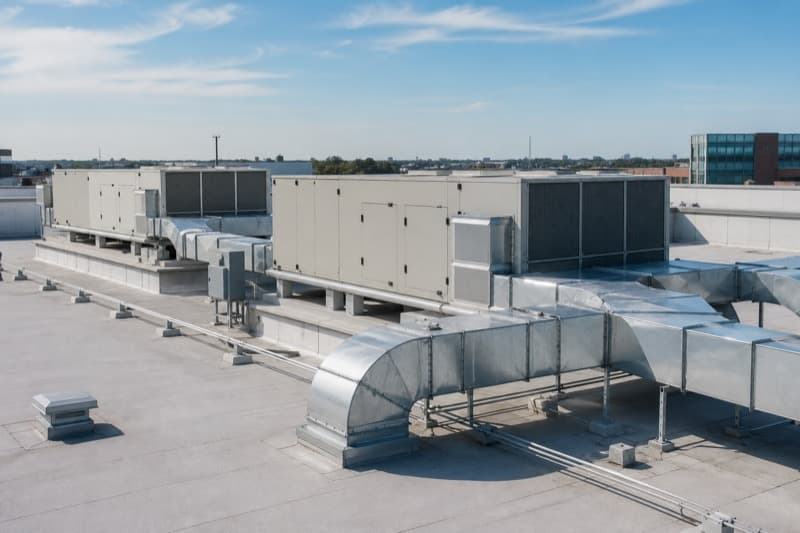
Air handling units (AHUs) condition, filter, and circulate air for a building's ductwork network, built around a fan, coil, and filter bank inside a common casing. NLS sources AHUs sized for Saudi outdoor air conditions, with filtration stages matched to hospital and clean-environment air-change requirements, for hospital, hotel, and commercial building projects across the Kingdom.
Chillers produce chilled water that circulates through a building's air handling units and fan coils, using either an air-cooled or water-cooled condenser. NLS sources air-cooled and water-cooled chillers derated for the Saudi 50°C design ambient, sized in refrigeration tons, for hospital, hotel, and large commercial cooling plants across the Kingdom.
Fan coil units (FCUs) draw room air across a chilled or hot water coil and a fan to condition individual rooms or zones, fed from a central chiller or boiler plant. NLS sources ducted, ceiling-concealed, cassette, and vertical FCU types for hotel, hospital, and residential-tower projects across Saudi Arabia, sized to the room load and duct or free-blow layout each project specifies.
Ventilation fans move fresh, exhaust, or smoke-extraction air through a building's duct system or directly between spaces, sized by airflow volume and static pressure rather than temperature control. NLS sources axial, centrifugal, and jet fans for car park ventilation, kitchen exhaust, smoke extraction, and general building ventilation across Saudi commercial and industrial projects.
Ductwork and accessories carry conditioned air from air handling units and fans to diffusers and grilles, including dampers, silencers, flexible connections, and fire/smoke dampers at compartment boundaries. NLS sources galvanized steel and pre-insulated ductwork with the full accessory range for hospital, commercial, and industrial HVAC installations across Saudi Arabia.
HVAC control systems (BMS/DDC) monitor and adjust chillers, AHUs, fans, and FCUs to maintain setpoints while minimizing run time and energy draw. NLS sources DDC controllers, sensors, and BMS front-end software for hospital, hotel, and commercial buildings across Saudi Arabia, scoped to the points list and sequence of operations each project's mechanical design specifies.
Precision cooling units hold tight temperature and humidity tolerances for data centre, telecom, and control room environments, running continuously with tighter control bands than comfort cooling AHUs. NLS sources CRAC and CRAH precision units in N+1 redundant configurations, sized to server rack heat density, for data centre and critical-facility projects across Saudi Arabia.
Solar PV modules convert sunlight directly into DC electricity through semiconductor cells wired into a weatherproof panel. NLS sources monocrystalline and polycrystalline PV modules certified to IEC 61215 and IEC 61730, rated for the high irradiance and soiling conditions of Saudi sites, for utility, commercial rooftop, and off-grid solar projects across the Kingdom.
Solar inverters convert DC power from PV modules into grid-compliant AC power, in string, central, or micro-inverter configurations. NLS sources grid-tied solar inverters rated for Saudi ambient conditions and derated for cell temperature effects, sized from residential string inverters to utility-scale central inverters, for commercial, industrial, and utility solar projects across the Kingdom.
Hybrid inverters manage power flow between solar PV, battery storage, and the grid or a backup load panel from a single unit, switching automatically between modes. NLS sources hybrid inverters sized for combined PV and battery capacity, for commercial and residential projects across Saudi Arabia that need solar self-consumption with backup power during a grid outage.
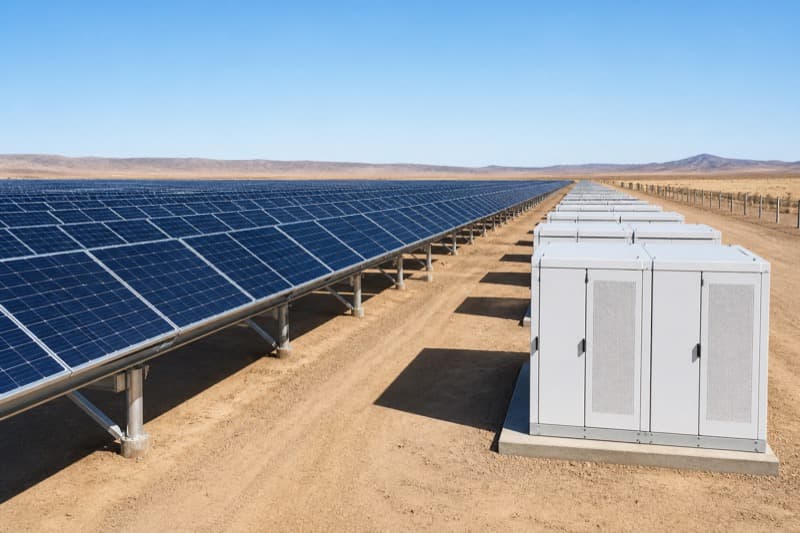
Battery energy storage systems (BESS) store DC electricity, typically from solar generation or off-peak grid supply, for later use during peak demand, an outage, or off-grid operation. NLS sources lithium iron phosphate (LFP) battery systems for their stability and cycle life in Saudi ambient conditions, sized from residential backup units to commercial and utility-scale containerized systems.
Solar mounting structures hold PV modules at a fixed or tracking tilt angle, anchored to a roof, ground foundation, or carport frame. NLS sources fixed-tilt and single-axis tracker mounting systems engineered for Saudi wind loading and corrosion resistance, for rooftop, ground-mount, and carport solar installations across the Kingdom.
Solar combiner boxes bring multiple PV string DC outputs together into one or more consolidated feeders, with fusing and surge protection on each string before the feeder reaches the inverter. NLS sources combiner boxes rated for outdoor Saudi ambient conditions and dust ingress, for commercial and utility-scale ground-mount and rooftop solar installations across the Kingdom.
Off-grid solar systems combine PV modules, battery storage, and an off-grid or hybrid inverter into a self-sufficient power source with no grid connection, sized against the site's daily load profile and lowest-sun days. NLS sources off-grid systems for remote Saudi sites, telecom towers, and construction camps where grid extension isn't practical or cost-effective.
Voltage stabilizers correct incoming supply voltage that drifts outside equipment tolerance, holding output within a tight band regardless of input swings. NLS sources servo-controlled and relay-type voltage stabilizers sized for the voltage drop and sag conditions common on long feeders at remote Saudi sites, protecting sensitive equipment on industrial, medical, and commercial installations.
Automatic voltage regulators (AVRs) hold generator or supply output voltage within a tight tolerance band as load and speed vary, sensing output continuously and adjusting excitation or a tap changer in response. NLS sources AVR units for standalone generators and larger tap-changing regulators for distribution feeders, matched to the voltage regulation class Saudi projects specify.
Power factor correction (PFC) banks add capacitor banks in parallel with an inductive load to reduce the reactive power a site draws from the grid, raising power factor toward unity and avoiding SEC low-power-factor penalty charges. NLS sources fixed and automatic PFC banks sized against a site's actual reactive load profile for industrial and commercial installations across Saudi Arabia.
Harmonic filters reduce voltage and current distortion caused by non-linear loads such as variable frequency drives, UPS systems, and LED lighting drivers, bringing a site's harmonic distortion within IEEE 519 limits. NLS sources passive and active harmonic filters sized against a site's actual measured harmonic spectrum for industrial and data centre installations across Saudi Arabia.
Surge protection devices (SPDs) clamp transient overvoltage from lightning strikes or switching events before it reaches connected equipment, installed at defined points in an electrical distribution system per IEC 61643 classification. NLS sources Type 1, Type 2, and Type 3 SPDs for main distribution boards, sub-panels, and sensitive equipment on industrial, commercial, and hospital installations across Saudi Arabia.
Power quality analyzers measure voltage, current, harmonics, power factor, and transient events at a point in an electrical system, providing the data needed to diagnose a problem before specifying a correction. NLS sources portable and panel-mounted power quality analyzers for site surveys and continuous monitoring on industrial, commercial, and data centre installations across Saudi Arabia.
Isolation transformers separate a load electrically from its supply through magnetic coupling with no direct conductive path, blocking common-mode noise and, on medical IT systems, removing the earthed reference fault current would otherwise need to trip a breaker. NLS sources isolation transformers for hospital operating theatre power systems, sensitive electronics, and general noise-isolation applications across Saudi Arabia.
Tell us what you need and we will come back with pricing and lead times.