
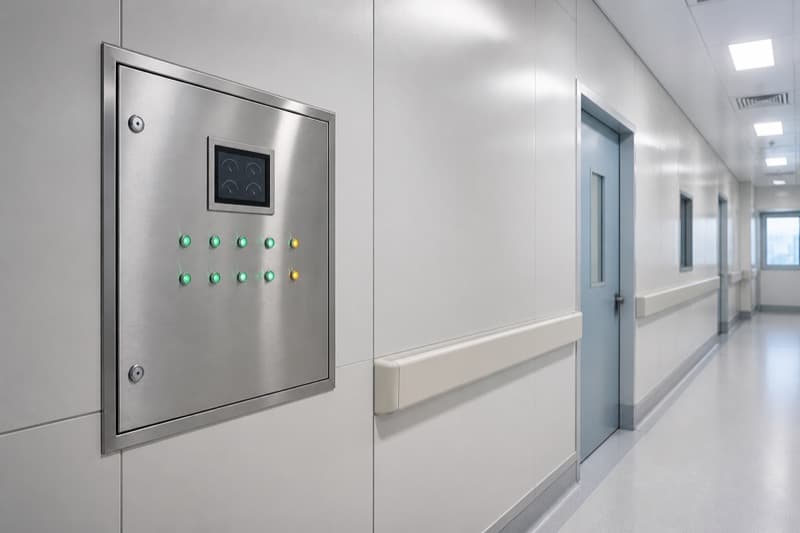
Equipotential Bonding Systems
An equipotential bonding system connects every exposed conductive surface in a Category 1 space, bed frames, equipment rails, plumbing, to a single reference point with low-impedance conductors, keeping any potential difference in the room low enough to protect a patient with a direct cardiac connection. NLS sources bonding components for Saudi hospital wet procedure locations.
A patient with a direct cardiac catheter or pacing lead has almost no natural resistance protecting the heart from stray electrical current, so a potential difference between two conductive surfaces in the room, a bed frame and an IV pole, for example, that would be completely harmless to someone standing on the floor can present a real microshock risk when the current path runs straight to the heart muscle. Equipotential bonding addresses this by connecting every exposed conductive surface in the room, bed frames, equipment rails and racks, plumbing fixtures, door and window frames, to a single patient equipotential grounding point using low-impedance bonding conductors.
The bonding jumper resistance between any two bonded points is kept low, commonly specified at 0.1 ohm or better, so that even a fault current passing through the system doesn't develop a meaningful voltage difference across the room. NFPA 99 sets out the bonding requirements for Category 1 spaces including operating rooms, and IEC 60364-7-710 sets an equivalent supplementary equipotential bonding requirement for medical IT locations, both aimed at the same outcome: no two points a patient or their equipment might touch should differ enough in potential to matter.
Bonding conductors run in addition to, not instead of, the normal protective earth conductor on each circuit, and every new piece of fixed equipment installed in the room, from an X-ray arm to a ceiling boom, needs its own bonding jumper back to the reference point rather than relying on the building steel or conduit as an incidental path.
NLS sources bonding busbars, jumpers, and the patient equipotential grounding point terminals used in Saudi hospital wet procedure locations, cath labs, and MRI suites, sized and routed against the room's equipment schedule and coordinated with the electrical contractor doing the bonding conductor installation.
Specifications
- ✓Function: bonds all exposed conductive surfaces in a Category 1 room to one patient equipotential grounding point
- ✓Bonding jumper resistance: typically 0.1 ohm or lower between any two bonded points
- ✓Standards referenced: NFPA 99 Category 1 bonding requirements, IEC 60364-7-710 supplementary equipotential bonding
- ✓Coverage: bed frames, equipment rails and racks, plumbing fixtures, door and window frames
- ✓Installed in addition to, not instead of, each circuit's protective earth conductor
- ✓Application: operating rooms, cath labs, and MRI suites where patients have a direct cardiac connection
Frequently Asked Questions
Why does an operating room need equipotential bonding?+
A patient with a direct cardiac catheter has almost no natural resistance to stray current, so even a small potential difference between two conductive surfaces in the room can pose a microshock risk. Bonding keeps that difference below a safe threshold.
What resistance is required for equipotential bonding jumpers?+
Bonding jumpers between conductive surfaces in a Category 1 room are typically specified at 0.1 ohm or lower, low enough that a fault current doesn't develop a meaningful voltage difference across the room.
Who supplies equipotential bonding components for Saudi hospital projects?+
NLS sources bonding busbars, jumpers, and patient equipotential grounding point terminals sized against the room's equipment schedule, coordinated with the electrical contractor installing the bonding conductors.
Who supplies Equipotential Bonding Systems in Saudi Arabia?+
NLS Power (Northlane Solutions Company) supplies Equipotential Bonding Systems across Saudi Arabia, including Riyadh, Jeddah, Dammam and Jubail. Send your specification and quantities to info@nlspower.com or info@northlanesolution.com for a quotation.