
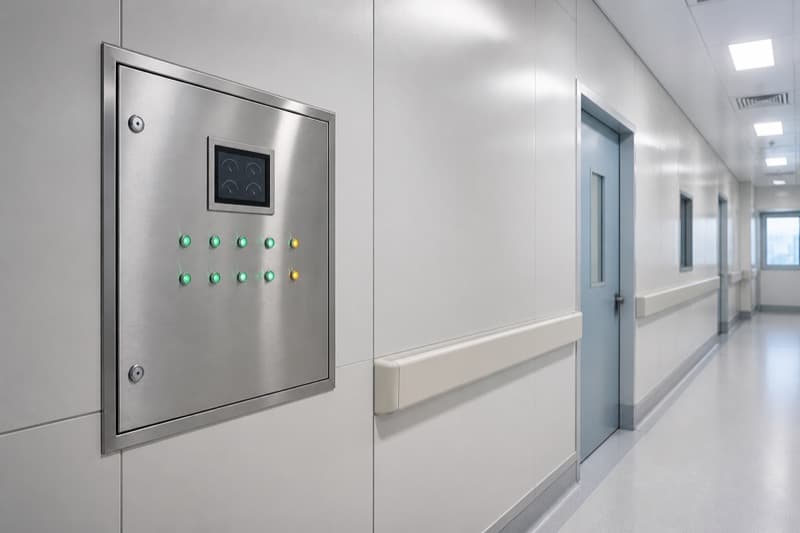
Line Isolation Monitors
A line isolation monitor (LIM) continuously watches an ungrounded medical power system for total hazard current and alarms before a second fault can create a shock risk in an operating room or other Category 1 space. NLS sources LIM units built to NFPA 99 alarm thresholds for Saudi hospital electrical infrastructure projects.
A line isolation monitor sits on the isolated secondary of a medical isolation transformer and continuously measures the total hazard current, the current that would flow if a second fault to ground occurred while a first fault already existed on the system. It does this without introducing a ground reference itself, since doing so would defeat the purpose of an ungrounded isolated system. NFPA 99 sets the alarm point at a total hazard current of 5 milliamps: below that, a fault is present but the system is still considered safe to keep running; at or above it, the monitor sounds an audible and visual alarm so staff can locate and clear the fault, typically by unplugging equipment one item at a time.
The monitor's own contribution to the hazard current reading has to stay small enough that it never masks a real fault, which is why the internal test circuitry in a compliant LIM is held to a fraction of a milliamp. Display is usually a 0-5mA analog or digital meter with green, amber, and red bands, paired with a remote annunciator at the room entrance so a circulating nurse sees the alarm without being inside the sterile field.
Where a project follows IEC rather than NFPA conventions, the equivalent device is an insulation monitoring device (IMD) under IEC 60364-7-710 for medical IT systems, typically set to alarm on insulation resistance rather than a milliamp threshold. Saudi hospital projects designed by US-trained consultants generally specify NFPA 99 LIM units; IEC-based designs specify an IMD instead, so the correct device depends on which code the electrical design follows, not on the country of installation.
NLS sources LIM and IMD units matched to the isolation transformer and panel already specified on a project, quoting against the panel schedule rather than as a standalone item, since the monitor has to be paired to the transformer's kVA rating and the room's branch circuit count to alarm correctly.
Specifications
- ✓Function: continuous monitoring of total hazard current on an ungrounded isolated power system
- ✓Alarm threshold: 5mA total hazard current per NFPA 99 for line isolation monitors
- ✓Display: 0-5mA meter with green/amber/red bands plus remote room-entrance annunciator
- ✓IEC equivalent: insulation monitoring device (IMD) per IEC 60364-7-710 for medical IT systems
- ✓Internal contribution: monitor's own hazard current kept to a fraction of a milliamp
- ✓Application: paired to the isolation transformer and panel serving the same Category 1 room
Frequently Asked Questions
What alarm threshold does a line isolation monitor use?+
NFPA 99 sets the alarm point at 5mA of total hazard current. Below that, the system stays live with a fault flagged; at or above it, the monitor triggers an audible and visual alarm for staff to locate the fault.
Is a line isolation monitor the same as an insulation monitoring device?+
They do the same job under different codes. NFPA 99 designs specify a line isolation monitor with a milliamp alarm threshold; IEC 60364-7-710 designs specify an insulation monitoring device that alarms on insulation resistance instead.
Who supplies line isolation monitors for hospitals in Saudi Arabia?+
NLS sources LIM and IMD units matched to the isolation transformer and panel already specified on a Saudi hospital project, sized against the panel schedule rather than quoted as a standalone item.
Who supplies Line Isolation Monitors in Saudi Arabia?+
NLS Power (Northlane Solutions Company) supplies Line Isolation Monitors across Saudi Arabia, including Riyadh, Jeddah, Dammam and Jubail. Send your specification and quantities to info@nlspower.com or info@northlanesolution.com for a quotation.