High Mast Lighting
High mast lighting mounts multiple floodlights on a pole from about 15 to 40 meters, on a lowering winch head, to light large open areas, highway interchanges, ports, rail yards, and industrial yards, from a few tall structures instead of many short poles. NLS sources high mast systems built to IEC 60598 and matched to Saudi wind-load requirements.
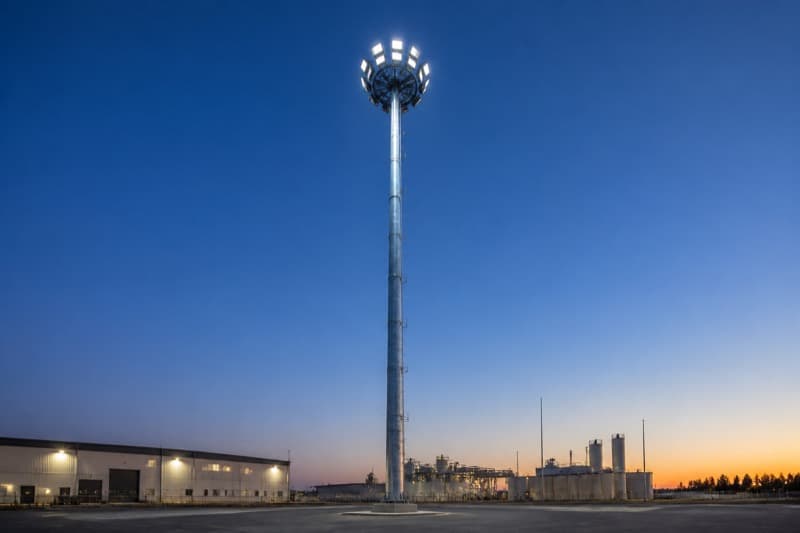
A high mast lighting system pairs a tall galvanized steel pole, typically 15 to 40 meters, with a luminaire ring carrying anywhere from four to twelve floodlights, raised and lowered on an internal winch or hoist so maintenance happens at ground level instead of on an aerial platform at height. A base compartment houses the photocell, timer, and lowering-device controls, and the whole assembly replaces what would otherwise take a dense grid of shorter poles to light the same open area.
Luminaire safety follows IEC 60598, while the pole itself is a structural design problem as much as a lighting one: wind load, not photometric output, usually governs pole wall thickness and foundation size on Saudi Arabia's open, wind-exposed sites. A pole sized against a generic wind map rather than the project's actual design wind speed and terrain category is one of the more common gaps NLS sees on a high mast spec that hasn't been engineered for its specific site.
High mast systems are the standard answer for highway interchanges, port and rail yard areas, industrial plant perimeters, and large open storage or laydown yards, anywhere the area to be lit is too large and too open for standard street lighting poles to cover economically. NLS sources high mast poles and luminaire packages matched to the wind zone, mounting height, and area lighting level a project specifies, for contractors and industrial sites across Saudi Arabia.
A project team typically sends the area dimensions, target lux level or photometric requirement, and site wind data (or the project's structural design wind speed if already established), and NLS returns a pole and luminaire package with a USD quote. Standard heights in stock configurations generally source faster than custom heights or non-standard luminaire counts, which need to go through pole fabrication and hot-dip galvanizing before they ship.
Specifications
- ✓Pole heights: approximately 15m to 40m, hot-dip galvanized steel construction
- ✓Luminaire ring typically carries 4 to 12 floodlights, raised/lowered on an internal winch or hoist for at-grade maintenance
- ✓Luminaire safety to IEC 60598; pole structural design governed by site wind load, not photometric output
- ✓Foundation design tied to project-specific wind speed, terrain category, and soil report, not a generic wind map
- ✓Typical use: highway interchanges, ports, rail yards, industrial perimeters, open storage and laydown yards
- ✓Base compartment houses photocell, timer, and lowering-device controls
Frequently Asked Questions
How tall is a high mast lighting pole?+
High mast poles typically run from about 15 meters up to 40 meters, with the height chosen against the area to be lit and the site's wind load rather than a fixed standard, since a taller pole covers more ground per structure but needs a heavier foundation.
Who supplies high mast lighting for highway and port projects in Saudi Arabia?+
NLS sources and supplies high mast pole and luminaire packages matched to Saudi wind-load requirements and project lux targets, for contractors on highway, port, rail yard, and industrial projects across the Kingdom.
How is a high mast pole maintained at 30 meters up?+
The luminaire ring lowers to ground level on an internal winch or hoist system built into the pole, so lamp changes and cleaning happen at grade rather than needing an aerial platform or crane at height.
Who supplies High Mast Lighting in Saudi Arabia?+
NLS Power (Northlane Solutions Company) supplies High Mast Lighting across Saudi Arabia, including Riyadh, Jeddah, Dammam and Jubail. Send your specification and quantities to info@nlspower.com or info@northlanesolution.com for a quotation.