
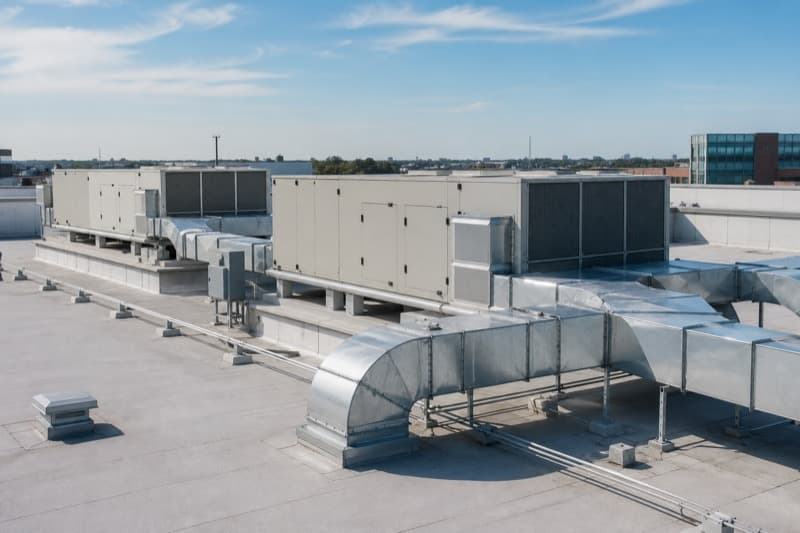
Precision Cooling Units
Precision cooling units hold tight temperature and humidity tolerances for data centre, telecom, and control room environments, running continuously with tighter control bands than comfort cooling AHUs. NLS sources CRAC and CRAH precision units in N+1 redundant configurations, sized to server rack heat density, for data centre and critical-facility projects across Saudi Arabia.
Precision cooling units, commonly CRAC (computer room air conditioner, with its own DX refrigeration circuit) or CRAH (computer room air handler, fed by chilled water from a central plant), are built to hold a tight temperature and humidity band around IT equipment continuously, 24/7/365, rather than the wider setpoint tolerance and occupancy-based scheduling a comfort cooling system runs on. The control tolerance is the defining feature: a comfort AHU might be specified to plus or minus 2°C, while a precision unit typically holds within a fraction of a degree along with a tight relative humidity band, because server hardware reliability and static discharge risk both depend on staying inside a narrow environmental envelope rather than simply staying cool.
Sizing a precision cooling unit starts from rack heat density in kW per rack, not floor area, since a modern high-density server rack can dissipate several times the heat of a rack from a decade ago in the same footprint. Airflow management, hot aisle/cold aisle containment, raised floor or overhead ducted supply, and unit placement relative to the rack rows all affect whether the rated cooling capacity actually reaches the equipment that needs it, rather than short-circuiting back to the unit's own return air path. Redundancy is standard practice on this equipment class: N+1 or 2N configurations mean the room's total cooling capacity survives a single unit failure or a unit taken offline for maintenance without an unplanned temperature excursion, and the redundancy level a specific facility needs depends on its uptime tier target.
Saudi data centre and control room projects add the same 50°C outdoor design ambient constraint that affects any DX-based cooling equipment, which pushes many larger facilities toward chilled-water CRAH units fed by a dedicated chiller plant rather than direct-expansion CRAC units reliant on rooftop condensers exposed to peak summer ambient. Telecom shelters and smaller control rooms more commonly use self-contained DX precision units where a full chilled water plant isn't justified by the room's size.
Sourcing runs from a heat load and redundancy requirement. A project's data centre or MEP consultant issues rack heat density, total room IT load in kW, and the redundancy tier required, and NLS returns unit selection, CRAC or CRAH, and a priced quote in USD, with lead time set by unit count and whether the order matches a standard capacity range.
Specifications
- ✓Types: CRAC (self-contained DX refrigeration) and CRAH (chilled water, fed from central plant)
- ✓Tight control tolerance: fraction-of-a-degree temperature band and controlled relative humidity, held continuously
- ✓Sized to rack heat density (kW/rack) and total room IT load, not floor area alone
- ✓Redundant configurations (N+1, 2N) standard for data centre and critical-facility uptime targets
- ✓Chilled-water CRAH commonly specified for larger Saudi facilities to manage 50°C outdoor design ambient
- ✓Airflow management (hot/cold aisle containment) coordinated with unit placement for effective cooling delivery
Frequently Asked Questions
Who supplies precision cooling units for data centres in Saudi Arabia?+
NLS sources CRAC and CRAH precision cooling units sized to rack heat density and configured for N+1 or 2N redundancy, for data centre, telecom, and control room projects across Saudi Arabia.
Why is Saudi heat a factor in data centre cooling design?+
The 50°C summer design ambient reduces the capacity of DX-based CRAC units relying on rooftop condensers, which pushes many larger facilities toward chilled-water CRAH units fed by a dedicated chiller plant that holds capacity better under peak heat.
What lead time should I expect for precision cooling units in KSA?+
Lead time depends on unit count, CRAC vs CRAH configuration, and whether the order matches a standard capacity range. NLS confirms the figure once the heat load and redundancy requirement are set.
Who supplies Precision Cooling Units in Saudi Arabia?+
NLS Power (Northlane Solutions Company) supplies Precision Cooling Units across Saudi Arabia, including Riyadh, Jeddah, Dammam and Jubail. Send your specification and quantities to info@nlspower.com or info@northlanesolution.com for a quotation.