Dry-Type Transformers
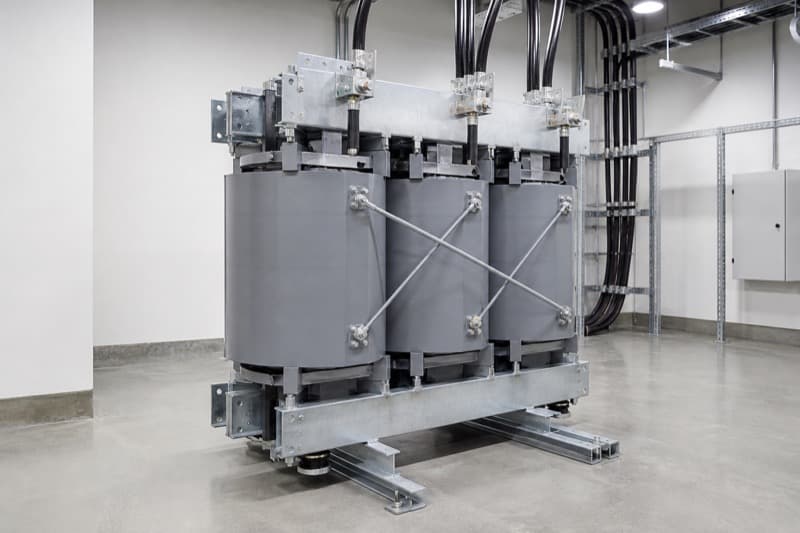
Dry-type transformers use air or resin-insulated windings instead of oil, which makes them the standard choice for basements, hospitals, high-rise risers and any indoor room where fire load and oil containment are a concern. NLS Power supplies dry-type units built to IEC 60076-11, in AN and AF cooling classes, sized to the vector group and rating an SEC connection requires.
A dry-type transformer insulates its windings with air, or with vacuum-pressure-impregnated resin, instead of the mineral oil a conventional distribution transformer uses. That single difference is why the category exists: no oil means no fire-suppression pit, no oil-retention bund, and a self-extinguishing fault behavior that lets a unit sit inside an occupied building rather than a dedicated outdoor yard. Hospital electrical rooms, basement substations in high-rise towers, data halls and metro stations specify dry-type for exactly this reason.
IEC 60076-11 sets the reference for the category, covering insulation class, partial discharge limits and the temperature rise test that determines whether a unit is rated Class F (155°C) or the more demanding Class H (180°C). Cooling comes in two classes: AN (natural air, convection only) for lighter and more typical loads, and AF (forced air, with fans) where the same frame needs a higher rating without a larger core and coil. Saudi specs often call for AF as a growth option even when the initial load only needs AN, since adding fans later means a shutdown the building can't always schedule.
Enclosure rating matters as much as the core design in this market. A unit sitting in an unventilated plant room needs a higher IP rating and a ventilation calculation that accounts for ambient temperatures well above the 40°C reference point IEC 60076 assumes as standard. NLS works this derating into the sizing conversation rather than leaving it for commissioning to discover. Vector group is typically Dyn11 for SEC-connected LV distribution duty, matching the grounding and phase-shift requirement most Saudi utility connections specify.
NLS sources dry-type transformers against the rating, vector group, cooling class and enclosure IP a project's single-line diagram and SEC connection approval call for, and returns a quote once those parameters and the delivery site are confirmed. Lead time depends mainly on winding size and whether the unit is a catalog rating or a made-to-order design.
Specifications
- ✓Insulation: air-cooled or vacuum-pressure-impregnated (VPI) resin windings, no oil, tested to IEC 60076-11
- ✓Cooling classes: AN (natural air) and AF (forced air with fans) for a higher rating on the same frame
- ✓Temperature class: F (155°C) standard, H (180°C) available for higher continuous duty
- ✓Vector group: Dyn11 standard for SEC-connected LV distribution, other groups on request
- ✓Enclosure: IP00 for switchgear-room mounting up to IP54 for exposed or dusty locations
- ✓Typical range: 100kVA to 3150kVA for indoor distribution duty
Frequently Asked Questions
What's the difference between a dry-type and an oil-immersed transformer?+
Dry-type transformers insulate the windings with air or resin instead of oil, so there's no fire-suppression pit or oil bund to build, which is why they're the default for indoor rooms, basements and occupied buildings. Oil-immersed units are generally more efficient at the same rating but need outdoor or dedicated-room installation with containment.
Where does a Saudi project actually need a dry-type transformer?+
Any indoor electrical room where fire code or building layout won't allow an oil-filled unit: hospital basements, high-rise riser rooms, data halls, and metro or airport terminal substations. Ventilation design has to account for Saudi ambient temperatures, since the room, not the transformer, usually sets the real derating limit.
What cooling class should I specify for a dry-type transformer in Saudi Arabia?+
AN (natural air) covers most standard indoor loads, but a lot of Saudi specs call for AF (forced air) headroom even on day-one loads that don't need it yet, because adding fans later means a shutdown. The right answer depends on room ventilation and how much load growth the design allows for.
Who supplies Dry-Type Transformers in Saudi Arabia?+
NLS Power (Northlane Solutions Company) supplies Dry-Type Transformers across Saudi Arabia, including Riyadh, Jeddah, Dammam and Jubail. Send your specification and quantities to info@nlspower.com or info@northlanesolution.com for a quotation.