
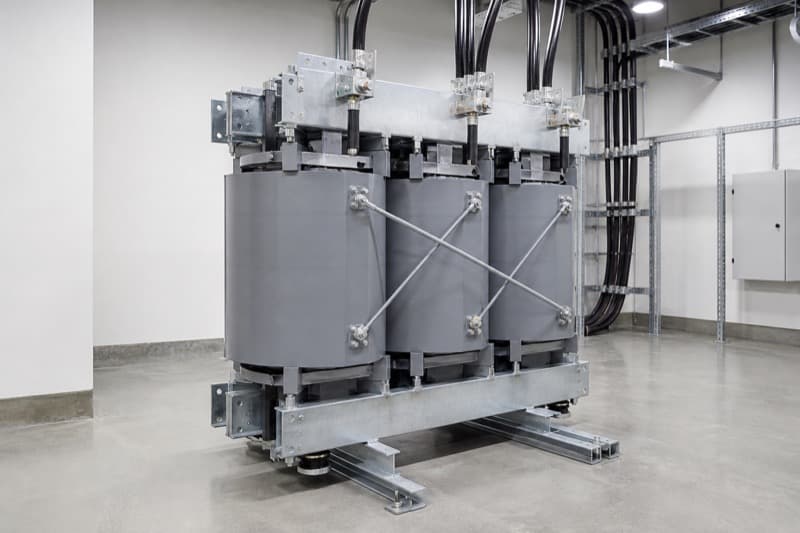
Oil-Immersed Transformers
Oil-immersed transformers use mineral oil or synthetic ester both to insulate the windings and to carry heat away, which makes them more efficient per kVA than a dry-type unit at the same rating. NLS Power supplies oil-immersed transformers built to IEC 60076, in ONAN and ONAF cooling classes, for outdoor SEC-connected substations across Saudi Arabia.
Oil-immersed transformers use mineral oil, or increasingly synthetic or natural ester fluid, as both the winding insulation and the cooling medium. The oil circulates past the core and coil, picks up heat, and gives it up through radiators, either by natural convection (ONAN) or with fans forcing air across the radiators (ONAF) when the load needs a higher rating from the same tank. Larger transmission-class units add oil pumps (OFAF or ODAF) to move the fluid itself, though that scale sits above what most commercial and industrial Saudi projects specify.
Because the fluid is combustible, an oil-immersed unit needs an outdoor location or a dedicated fire-rated substation room, an oil-retention pit or bund sized to the full oil volume, and separation distances from occupied buildings that a dry-type unit doesn't require. In exchange, oil-immersed transformers run cooler for a given core and coil size, handle short-term overload better, and are generally the lower-cost option at ratings above roughly 1000kVA, which is why SEC-connected outdoor substations on industrial and utility-scale projects default to this type.
Vector group is almost always Dyn11 for SEC LV distribution duty, and the connection approval process will specify no-load and load loss limits, since a transformer's core loss runs continuously for the full life of the installation regardless of connected load. That steady loss is what drives lifetime energy cost more than the load loss does on a lightly loaded unit. Tap changers, off-circuit as standard or on-load where voltage regulation is needed, let the secondary voltage be trimmed to actual site conditions rather than the nameplate value.
Coastal sites near Jubail or Yanbu need extra attention to tank coating and radiator material, since salt-laden air corrodes standard paint systems faster than it does inland. NLS sources oil-immersed transformers against the rating, cooling class, vector group and loss class an SEC connection or project spec calls for.
Specifications
- ✓Insulation and cooling: mineral oil or ester fluid, natural or forced circulation, per IEC 60076-2
- ✓Cooling classes: ONAN standard, ONAF for a higher rating on the same tank, OFAF on larger units
- ✓Vector group: Dyn11 standard for SEC LV distribution, other groups available for step-up or special duty
- ✓Tap changer: off-circuit as standard, on-load tap changer (OLTC) where automatic voltage regulation is specified
- ✓Installation: outdoor or dedicated fire-rated room, with an oil-retention pit or bund sized to full oil volume
- ✓Loss class: no-load and load loss limits set against IEC 60076-20 efficiency tiers or the SEC connection spec
Frequently Asked Questions
Is an oil-immersed transformer more efficient than a dry-type unit?+
Generally yes, at the same kVA rating an oil-immersed unit runs lower no-load and load losses than a comparable dry-type transformer, mainly because oil is a more effective heat-transfer medium than air. The gap narrows at smaller ratings, and the dry-type's indoor-siting advantage often outweighs the efficiency difference on space-constrained sites.
Why does no-load loss matter more than load loss over a transformer's life?+
No-load loss (core loss) runs continuously for as long as the transformer is energized, whether or not it's carrying load, so it accumulates over the full installation life. Load loss only applies when current is flowing, so a unit sized with margin above its typical load carries a fixed core-loss cost that a loss-class spec is meant to control.
Can an oil-immersed transformer go inside a building in Saudi Arabia?+
Only in a dedicated fire-rated substation room built with an oil-retention pit or bund sized to the transformer's full oil volume, fire separation from occupied areas, and ventilation for the ambient the room will actually see. Most Saudi projects still default to outdoor siting for oil-immersed units where the plot allows it.
Who supplies Oil-Immersed Transformers in Saudi Arabia?+
NLS Power (Northlane Solutions Company) supplies Oil-Immersed Transformers across Saudi Arabia, including Riyadh, Jeddah, Dammam and Jubail. Send your specification and quantities to info@nlspower.com or info@northlanesolution.com for a quotation.