
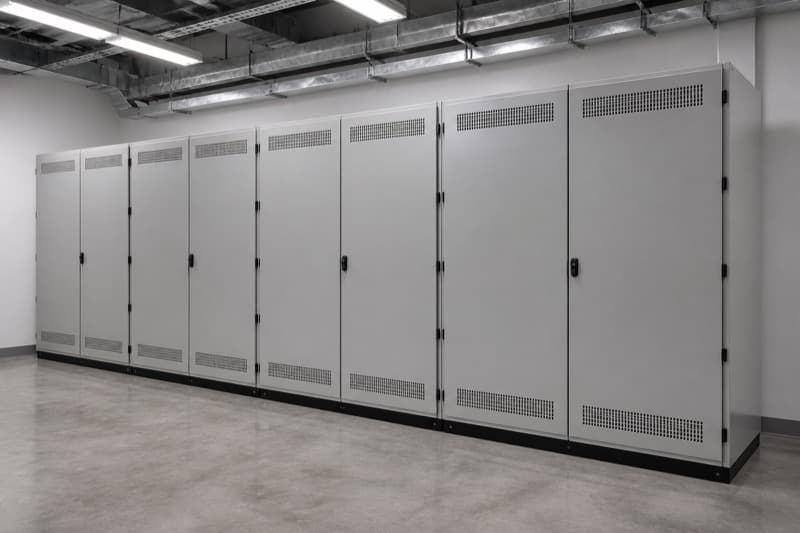
Main Distribution Boards
A main distribution board (MDB) takes power from the LV switchgear or transformer and splits it into the large feeders that run to sub distribution boards, MCCs and major equipment across a building or plant. NLS Power sources MDBs built to IEC 61439-1/2, with breaking capacity and busbar rating matched to the site's fault level.
The main distribution board is the second tier down from LV switchgear: where the switchgear carries the full incoming supply on one or two busbar sections, the MDB takes a large feeder from it and splits that current into the handful of major outgoing ways that serve a building floor group, a process unit, or a set of sub distribution boards further down the chain. On a mid-size commercial or industrial building it's common for the MDB itself to be part of the main LV switchgear lineup rather than a separate room, while larger sites run MDBs in each building or block, fed from a central switchgear room.
Breaking capacity on the incoming and outgoing devices has to be checked against the actual fault level at that point, not against a generic assumption carried over from a different project. An MDB installed one floor away from the transformer sees a different fault current than one at the switchgear room itself, because cable and busbar impedance between the two points reduces the fault current the further downstream you go; sizing an MDB breaker without that calculation either wastes money on unnecessary breaking capacity or, worse, under-rates it.
Arc flash exposure is a real consideration at MDB level because technicians open these boards more often than switchgear, for metering checks, breaker maintenance, and load additions. Incident energy calculations, arc flash labeling, and a documented safe working distance are becoming standard requirements on Saudi hospital and data centre specifications even though the formal driver, NFPA 70E, is a US standard; IEC-based projects reference IEC/TR 61641 for the equivalent internal arc consideration.
NLS Power sources main distribution boards to IEC 61439-1/2, with incoming ACB or MCCB, form of separation matched to the project spec, and busbar and breaker ratings confirmed against the protection study rather than assumed. Quoting works from the single line diagram, the outgoing feeder schedule, and the fault level at the board; NLS Power returns pricing in USD with delivery phased to match the building's floor-by-floor handover schedule where relevant.
Specifications
- ✓Type tested to IEC 61439-1/2, form of separation matched to project specification
- ✓Incoming device: air circuit breaker (ACB) or moulded case circuit breaker (MCCB) sized to the transformer or switchgear feeder
- ✓Breaking capacity (Icu/Ics) verified against fault level at the actual board location, not assumed
- ✓Busbar rated current sized to the sum of outgoing feeders plus spare capacity
- ✓Arc flash incident energy labeling available on request per project specification
- ✓Outgoing feeders sized to sub distribution boards, MCCs and major fixed equipment
Frequently Asked Questions
What's the difference between a main distribution board and LV switchgear?+
LV switchgear carries the full incoming supply directly from the transformer or generator. The MDB sits one step downstream, taking a large feeder from the switchgear and splitting it into the major outgoing ways that reach sub distribution boards and equipment.
Who supplies main distribution boards in Saudi Arabia?+
NLS Power sources MDBs built to IEC 61439-1/2, with breaker ratings verified against the actual fault level at the board rather than assumed, for commercial, industrial and healthcare projects across KSA.
Does an MDB need arc flash labeling in Saudi Arabia?+
It depends on the project specification. Hospital and data centre clients increasingly ask for incident energy calculations and arc flash labels even on IEC-based designs, since technicians open these boards routinely for metering and maintenance work.
Related products
Sub Distribution Boards
A sub distribution board (SDB) is the final panel between the main distribution board and the circuits feeding lighting, small power and local equipment on a floor or in a room. NLS Power sources SDBs built to IEC 61439-3, sized to the final circuit schedule and the form of separation a project's electrical spec calls for.
Busway & Busduct
Busway, or busduct, is a factory-built enclosed conductor system that replaces cable and tray for carrying large currents through building risers and long industrial runs, with tap-off points that let a load be added without pulling new cable. NLS Power sources busway built to IEC 61439-6, rated from 250A up to 6300A, for towers, data centres and plants where load will change.
Air Circuit Breakers (ACB)
An air circuit breaker (ACB) is the main protection and switching device at the top of an LV switchgear or main distribution board, rated from around 630A up to 6300A, built to interrupt current in open air rather than a moulded enclosure. NLS Power sources ACBs to IEC 60947-2, with electronic trip units sized to the switchboard's fault level.
Moulded Case Circuit Breakers (MCCB)
A moulded case circuit breaker (MCCB) protects feeders and equipment from around 16A up to roughly 2500A inside a sealed insulated case, sitting between an ACB upstream and MCBs on final circuits downstream. NLS Power sources MCCBs to IEC 60947-2, with thermal-magnetic or electronic trip units, sized to each feeder's load and fault current.
Panel Meters
Panel meters read and display voltage, current, power, energy and power quality data on a distribution board, ranging from a simple analogue ammeter to a multifunction meter feeding a building management system. NLS Power sources panel meters to IEC 61557 and IEC 62053 accuracy classes, with Modbus communication for sub-metering and tenant billing on Saudi commercial and industrial projects.
Current Transformers
A current transformer (CT) steps down a high primary current to a small, standard secondary signal, typically 5A or 1A, that a meter or protection relay can safely read. NLS Power sources CTs to IEC 61869-2, in metering and protection accuracy classes, sized to the busbar or cable current a project's switchboard and metering schedule specifies.