Obstruction Lighting
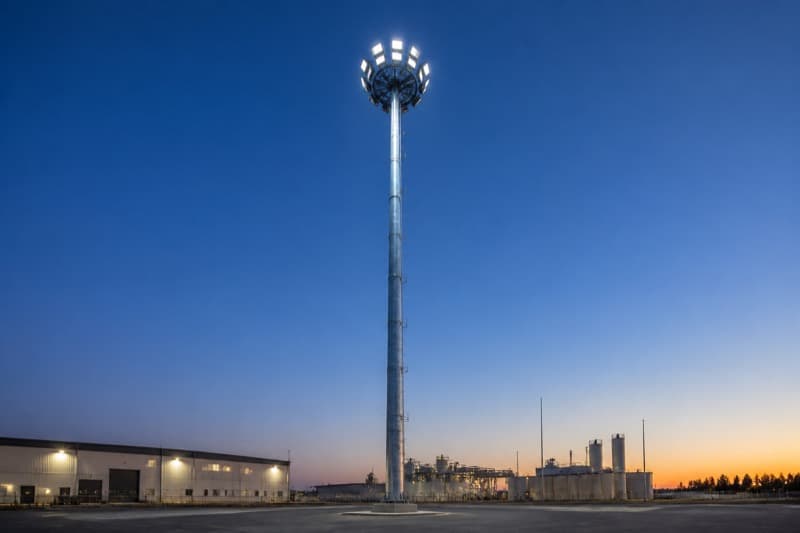
Obstruction lighting marks tall structures, towers, cranes and buildings that penetrate airspace so aircraft can see and avoid them at night and in low visibility. NLS supplies LED low, medium and high intensity obstruction lights built to ICAO Annex 14 and FAA AC 150/5345-43 for GACA-regulated structures across Saudi Arabia, and this is one of the company's core specialisms.
Any structure that penetrates the obstacle limitation surfaces around an airport, or simply stands tall enough to be a hazard to low-flying aircraft, needs obstruction lighting sized to its height and location. The classification runs from low intensity Type A/B steady red lights on shorter structures, through medium intensity Type A/B/C white or red flashing units on mid-height towers, up to high intensity Type A dual white-day/red-night systems on structures above roughly 150 meters, where ICAO and FAA guidance both call for a stronger signal to fast-moving aircraft.
NLS has built its supply practice specifically around this category, sourcing LED obstruction light fixtures against ICAO Annex 14 Volume I and the FAA's AC 150/5345-43 fixture specification, the two reference frameworks GACA aligns to for lighting compliance on Saudi towers, cranes, transmission structures, minarets, and rooftop plant. LED fixtures now dominate new installations over the older incandescent and strobe-tube designs because they cut power draw sharply, run for tens of thousands of hours before a lamp change, and hold consistent intensity output through their service life, which matters for a fixture a maintenance crew doesn't want to climb to service every year.
Across Saudi Arabia, obstruction lighting shows up on telecom towers, wind measurement masts, tower cranes on giga-project sites, transmission line pylons, tall minarets near flight paths, and rooftop mechanical plant on high-rise buildings in Riyadh and the Eastern Province. Each application has its own height threshold and flash pattern requirement set by the aeronautical study for that site, and getting the intensity class wrong is one of the more common findings when a structure goes through GACA obstacle assessment.
A project team typically comes to NLS with a structure height, location, and the flash characteristic called out in its aeronautical study or NOTAM filing, and NLS returns a fixture recommendation and USD quote matched to that classification, along with the constant-current or photocell control gear the installation needs. Lead time depends on fixture type and quantity, with standard low and medium intensity units generally available faster than high intensity dual-mode systems built to order.
Specifications
- ✓Classification per ICAO Annex 14 Volume I: low, medium and high intensity Type A/B/C obstruction lights
- ✓FAA AC 150/5345-43 fixture specification, referenced by GACA for obstruction lighting compliance
- ✓LED light source with typical service life above 50,000 hours
- ✓High intensity Type A units in dual white-day / red-night configuration for structures above approximately 150m
- ✓Constant current regulator (CCR) or standalone photocell/battery-backed control options
- ✓IP66-rated weatherproof housings for exposed tower, crane and rooftop mounting
Frequently Asked Questions
How do I know which intensity class my structure needs?+
The aeronautical study or obstacle assessment done for your structure's height and location specifies the intensity class and flash pattern GACA requires. If that study has not been done yet, NLS can indicate the likely class from height and proximity to a flight path, but the binding requirement comes from the formal assessment.
Do construction cranes need obstruction lighting in Saudi Arabia?+
Yes, where the crane penetrates the obstacle limitation surfaces around an aerodrome or exceeds the height threshold that applies at that location. Crane lighting is usually temporary and battery or solar backed, since a tower crane rarely has a permanent supply at the jib.
What is the difference between low, medium and high intensity obstacle lights?+
Intensity rises with the height of the obstacle and the background lighting conditions. Low intensity steady red units suit lower structures, medium intensity flashing red or white units suit taller ones, and high intensity white units are used on very tall structures and where daytime conspicuity is required.
Who supplies Obstruction Lighting in Saudi Arabia?+
NLS Power (Northlane Solutions Company) supplies Obstruction Lighting across Saudi Arabia, including Riyadh, Jeddah, Dammam and Jubail. Send your specification and quantities to info@nlspower.com or info@northlanesolution.com for a quotation.