
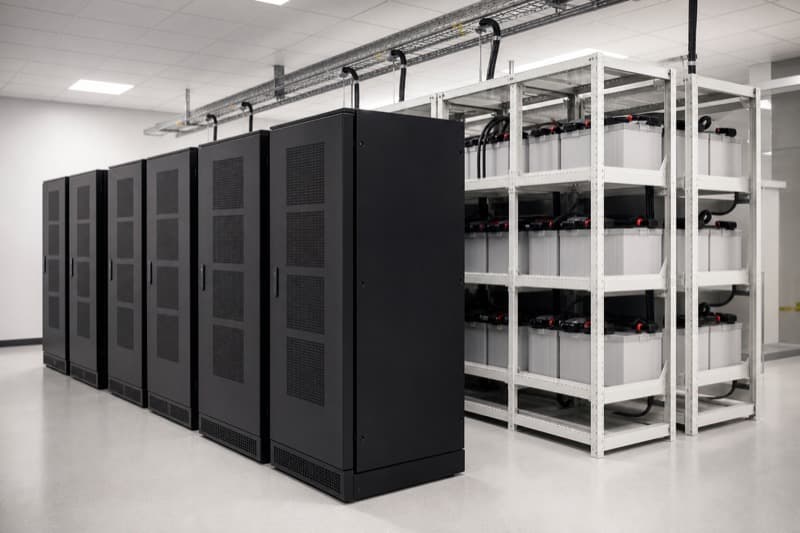
Modular UPS Systems
A modular UPS builds capacity from hot-swappable power modules, typically 25-100kW blocks, inside one frame, so N+1 redundancy comes from adding one extra module rather than a second full UPS, and a failed module gets replaced live without dropping the load. NLS sources modular UPS platforms for Saudi data centre N+1 and phased-growth deployments.
A monolithic UPS is bought and sized once: a 200kVA unit stays a 200kVA unit whether the connected load is 50kVA on day one or 190kVA three years later, and getting true redundancy means installing a second complete 200kVA unit alongside it. A modular UPS instead builds capacity from individual power modules, commonly in 25kW, 50kW, or 100kW blocks, slotted into a shared frame with common battery and bypass infrastructure.
Two things follow from that. First, redundancy gets cheaper: if a data hall's calculated load needs 150kW, the frame is populated with modules totaling 175-200kW rather than duplicating a whole separate UPS, and N+1 redundancy means only one extra module beyond what the load requires, not a second complete system. Second, a failed module can be pulled and replaced while the frame keeps running on its remaining modules, cutting mean time to repair from a scheduled maintenance window down to the time it takes to swap a module, since there's no need to route the load onto a bypass path for an internal repair the way a monolithic unit often requires.
This suits phased data centre buildouts particularly well: a facility can install a partially populated frame at commissioning and add modules as IT load grows, rather than buying a full-capacity monolithic UPS on day one that runs underloaded, and inefficiently, for its first two or three years of service.
NLS sources modular UPS platforms sized by module count and frame capacity to a project's current and projected load, for Saudi data centre N+1 and phased-growth deployments where the redundancy strategy and future expansion plan are defined before the frame is ordered.
Specifications
- ✓Architecture: hot-swappable power modules, typically 25kW, 50kW, or 100kW blocks, in a shared frame
- ✓Redundancy: N+1 achieved by one extra module rather than a duplicate full-capacity UPS
- ✓Maintainability: failed module replaced live without routing the load to bypass
- ✓Scalability: frame can be partially populated at commissioning and expanded as IT load grows
- ✓Standards referenced: IEC 62040-3 classification applies at the module and frame output level
- ✓Application: data centre N+1 architectures and phased-growth facility buildouts
Frequently Asked Questions
How does a modular UPS achieve redundancy more cheaply than a monolithic UPS?+
Redundancy comes from populating the frame with one module beyond the calculated load, N+1, rather than installing a second complete UPS at full capacity. The shared frame, battery, and bypass infrastructure only need to exist once.
Can a modular UPS be repaired without shutting down the load?+
Yes. A failed power module can be pulled and swapped while the remaining modules in the frame keep supporting the load, which cuts repair time down to a module swap instead of a scheduled maintenance window on bypass.
Who supplies modular UPS systems for Saudi data centres?+
NLS sources modular UPS platforms sized by module count and frame capacity to a project's current and projected load, for Saudi data centre N+1 architectures and phased-growth deployments.
Who supplies Modular UPS Systems in Saudi Arabia?+
NLS Power (Northlane Solutions Company) supplies Modular UPS Systems across Saudi Arabia, including Riyadh, Jeddah, Dammam and Jubail. Send your specification and quantities to info@nlspower.com or info@northlanesolution.com for a quotation.