
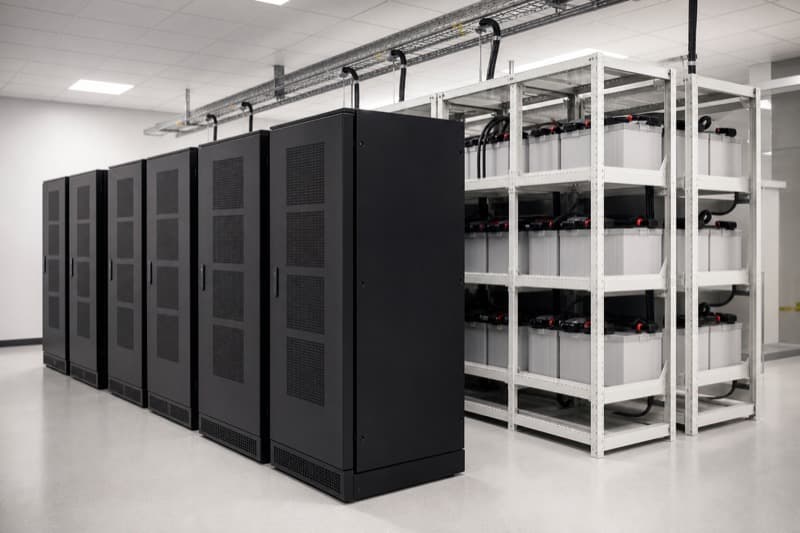
UPS Battery Banks
A UPS battery bank is a string of VRLA batteries sized to the UPS DC bus voltage, rated for a defined design life at a 20-25°C reference temperature. Every 8-10°C above that reference roughly halves service life, so battery room cooling matters in Saudi ambient conditions. NLS sources VRLA battery strings sized to project autonomy requirements.
A VRLA (valve-regulated lead-acid) battery string supplies the DC bus a UPS's inverter draws from during an outage, sized in series to match the UPS bus voltage, commonly assembled from 12V blocks wired into strings of 20, 40, or more depending on the bus design, and sized in parallel strings for the runtime a project needs.
VRLA batteries carry a design life quoted against a 20-25°C reference temperature under standards like IEC 60896-21/22, typically 5 to 10 years depending on the product line. That number assumes the battery room actually holds that temperature. Stationary battery life follows a well-established thermal rule: roughly every 8-10°C above the reference temperature cuts expected service life in half. A battery room running at 35-40°C without dedicated cooling, not unusual in a Saudi plant room or rooftop enclosure without HVAC, can turn a 10-year rated string into one that needs replacing in 3-5 years, well before the UPS itself is due for an upgrade.
This makes battery room ventilation and cooling a real line item on the cost of ownership, not a detail to defer. A project spending more on cooling can spend less over the equipment's life on battery replacement, and the tradeoff is worth running as an actual calculation rather than assuming ambient heat is someone else's problem once the UPS is commissioned.
NLS sources VRLA battery strings sized to the UPS bus voltage and the autonomy a project specifies, in the voltage and Ah ratings the design calls for, and flags where the expected ambient in a battery room will materially shorten the rated design life against the manufacturer's reference temperature.
Specifications
- ✓Chemistry: VRLA (valve-regulated lead-acid), assembled from 12V blocks into series strings
- ✓Sizing: string voltage matched to the UPS DC bus, parallel strings sized for required runtime
- ✓Design life: typically 5-10 years at a 20-25°C reference temperature per IEC 60896-21/22
- ✓Thermal derating: roughly every 8-10°C above the reference temperature halves expected service life
- ✓Application: bridges the gap between utility loss and generator start, or covers the full outage on smaller loads
- ✓KSA consideration: battery room ventilation/cooling design materially affects actual service life
Frequently Asked Questions
How much does high ambient temperature shorten VRLA battery life?+
Roughly every 8-10°C above the 20-25°C reference temperature the design life is rated against cuts expected service life in half. A battery room running at 35-40°C without cooling can see a 10-year string fail in 3-5 years.
How is a UPS battery string sized?+
String voltage is set to match the UPS DC bus, typically built from 12V blocks in series, and the number of parallel strings is sized to deliver the runtime, in minutes or hours, the project specifies.
Who supplies UPS battery banks for Saudi projects?+
NLS sources VRLA battery strings sized to the UPS bus voltage and required autonomy, flagging where expected battery room ambient will shorten the rated design life against the manufacturer's reference temperature.
Who supplies UPS Battery Banks in Saudi Arabia?+
NLS Power (Northlane Solutions Company) supplies UPS Battery Banks across Saudi Arabia, including Riyadh, Jeddah, Dammam and Jubail. Send your specification and quantities to info@nlspower.com or info@northlanesolution.com for a quotation.