
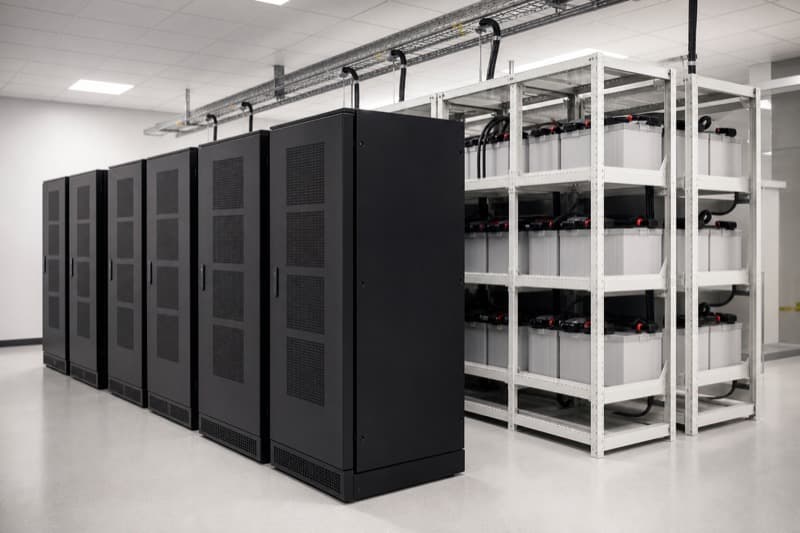
Lithium UPS Batteries
Lithium (LFP) UPS battery cabinets replace VRLA strings with roughly 60-70% less footprint and weight for the same runtime, wider ambient tolerance, and thousands more charge cycles over their service life. Each cabinet carries its own battery management system reporting cell health. NLS sources LFP battery cabinets built to IEC 62619 for Saudi hospital and data centre UPS installations.
Lithium iron phosphate (LFP) has moved from a novelty to a mainstream option for stationary UPS battery cabinets over the last several years, and the case for it in a Saudi installation rests on the same thermal problem that shortens VRLA life in the first place. LFP cells tolerate a wider ambient temperature range without the same aggressive life reduction VRLA sees, and their cycle life runs into the thousands of full discharge cycles, against a few hundred for VRLA under deep discharge, which matters on sites where the UPS actually sees frequent utility interruptions rather than sitting untouched for years.
Footprint and weight are the other practical driver: an LFP cabinet delivering the same runtime as a VRLA string typically needs roughly 60-70% less floor space and weighs a fraction as much, which matters in a retrofit where the battery room wasn't sized for a lead-acid string in the first place, or on an upper floor where structural loading is a real constraint.
Every LFP cabinet ships with its own battery management system (BMS), monitoring individual cell voltage, temperature, and state of charge, and communicating that back to the UPS or to a separate monitoring platform, a level of built-in intelligence a VRLA string doesn't have on its own. IEC 62619 is the referenced safety standard for secondary lithium cells and batteries in stationary applications, covering the cell and pack-level protections a UPS-grade cabinet needs.
Upfront cost per kWh of storage runs higher than VRLA, a real factor a project has to weigh, but the calculation should include the VRLA replacement cycles a hot battery room drives, alongside the two technologies' sticker prices. NLS sources LFP battery cabinets sized to a project's UPS bus voltage and runtime requirement for Saudi hospital and data centre installations.
Specifications
- ✓Chemistry: lithium iron phosphate (LFP), packaged in cabinets with an integrated battery management system
- ✓Footprint: roughly 60-70% smaller and lighter than a VRLA string for equivalent runtime
- ✓Cycle life: thousands of full discharge cycles versus a few hundred for VRLA under deep discharge
- ✓Thermal tolerance: wider ambient operating range than VRLA before life is materially reduced
- ✓Standards referenced: IEC 62619 for safety of secondary lithium cells/batteries in stationary applications
- ✓Monitoring: per-cell voltage, temperature, and state of charge reported by the built-in BMS
Frequently Asked Questions
Why choose lithium over VRLA for a UPS battery bank?+
LFP cabinets take roughly 60-70% less space and weight for the same runtime, tolerate a wider temperature range, and last through thousands more charge cycles than VRLA, which matters most in hot battery rooms with frequent utility interruptions.
Does a lithium UPS battery cabinet need its own monitoring system?+
It ships with one built in. The battery management system (BMS) inside each cabinet already tracks per-cell voltage, temperature, and state of charge and reports it to the UPS or monitoring platform.
Who supplies lithium UPS battery cabinets in Saudi Arabia?+
NLS sources LFP battery cabinets built to IEC 62619, sized to a project's UPS bus voltage and runtime requirement, for Saudi hospital and data centre installations.
Who supplies Lithium UPS Batteries in Saudi Arabia?+
NLS Power (Northlane Solutions Company) supplies Lithium UPS Batteries across Saudi Arabia, including Riyadh, Jeddah, Dammam and Jubail. Send your specification and quantities to info@nlspower.com or info@northlanesolution.com for a quotation.