
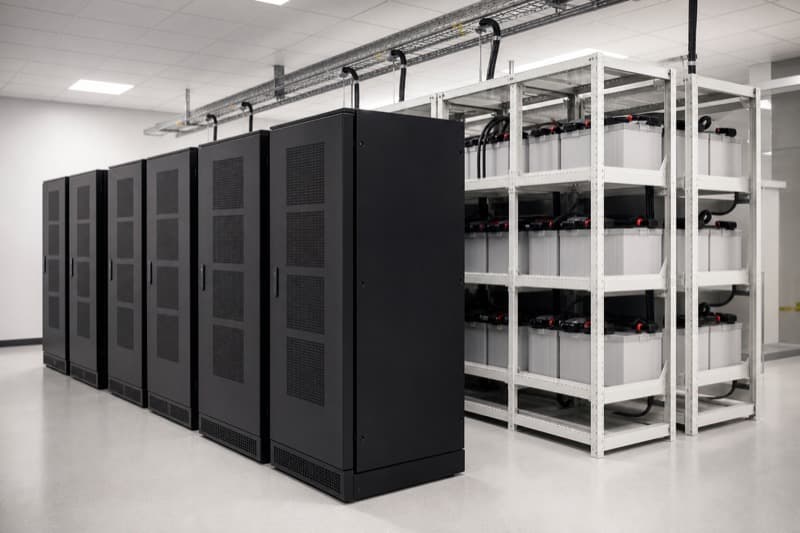
Battery Monitoring Systems
A battery monitoring system tracks per-string or per-cell voltage, internal resistance, and temperature on a UPS battery bank, flagging a weakening cell before a runtime test would reveal it. This matters in Saudi battery rooms, where uneven heat exposure ages cells within the same string at different rates. NLS sources monitoring platforms for VRLA and lithium UPS banks.
A UPS battery string is only as reliable as its weakest cell, and a weak cell doesn't announce itself between scheduled maintenance discharges. Internal resistance rises gradually as a cell ages, well before the terminal voltage drops enough to notice on a casual inspection, and by the time a cell fails a runtime test outright, it may already have been dragging the whole string's capacity down for months.
A battery monitoring system addresses this by measuring internal resistance or impedance, voltage, and temperature at the individual cell or block level, continuously, rather than waiting for a periodic maintenance discharge to surface a problem. The practice this follows is set out in guidance like IEEE 1188, the recommended maintenance approach for VRLA batteries, which ties resistance trending and temperature monitoring directly to predicting cell failure ahead of an actual outage.
Temperature monitoring carries particular weight in a Saudi installation, since cells at the top of a rack or nearest a heat source inside the same battery room can run measurably hotter than cells at the bottom, ageing unevenly within a string that was installed as a single batch. Without per-cell monitoring, that uneven ageing goes unnoticed until the string's overall capacity has already dropped, at which point identifying which specific cells are dragging performance down requires a manual test rather than a monitoring system flag.
NLS sources battery monitoring platforms compatible with both VRLA strings and lithium (LFP) battery cabinets, sized to the string configuration and cell count on a given UPS installation.
Specifications
- ✓Function: continuous per-string or per-cell voltage, internal resistance, and temperature monitoring
- ✓Practice referenced: IEEE 1188 recommended maintenance practice for VRLA stationary batteries
- ✓Early warning: flags rising internal resistance before a scheduled runtime discharge test would reveal it
- ✓Compatibility: monitors both VRLA strings and lithium (LFP) battery cabinets
- ✓KSA relevance: catches uneven cell ageing driven by heat gradients within a battery room
- ✓Output: trending data to a UPS controller or a separate monitoring platform
Frequently Asked Questions
What does a battery monitoring system actually measure?+
It tracks internal resistance, voltage, and temperature at the individual cell or block level continuously, which surfaces a weakening cell well before it would fail a scheduled runtime discharge test.
Why does temperature monitoring matter more in a Saudi battery room?+
Cells near the top of a rack or a heat source can run measurably hotter than cells lower down, ageing unevenly within a string installed as one batch. Per-cell monitoring catches that before overall string capacity drops.
Who supplies battery monitoring systems for Saudi UPS installations?+
NLS sources battery monitoring platforms compatible with both VRLA strings and lithium battery cabinets, sized to the string configuration and cell count on a given installation.
Who supplies Battery Monitoring Systems in Saudi Arabia?+
NLS Power (Northlane Solutions Company) supplies Battery Monitoring Systems across Saudi Arabia, including Riyadh, Jeddah, Dammam and Jubail. Send your specification and quantities to info@nlspower.com or info@northlanesolution.com for a quotation.