
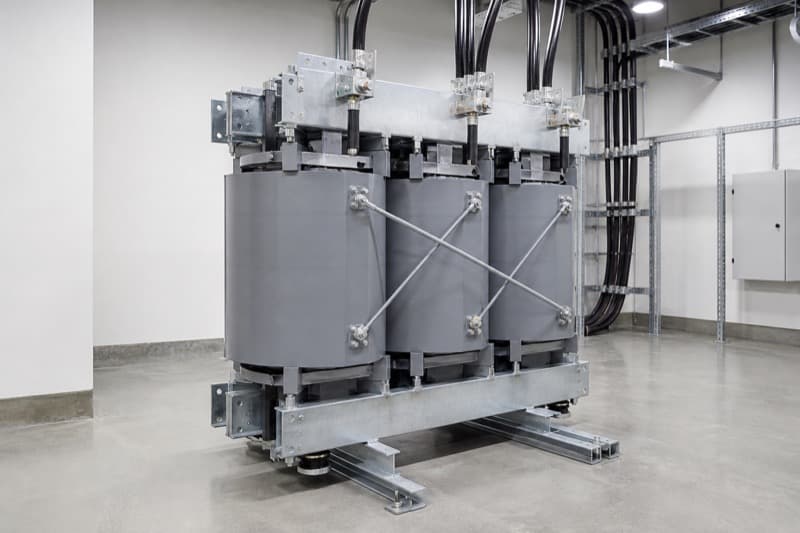
Transformer Protection Relays
Transformer protection relays detect internal and external faults, differential, restricted earth fault, overcurrent and temperature, and trip the transformer's circuit breakers before a fault causes structural damage or spreads to the wider network. NLS Power sources and supplies numerical protection relays with IEC 61850 communication for transformers on SEC-connected and industrial substations across Saudi Arabia.
A transformer is the single most expensive piece of equipment in most substations, and it's also one of the slowest to replace if it fails catastrophically, which is why its protection scheme gets more redundancy and more distinct fault-detection methods than almost any other item on a single-line diagram. Differential protection (ANSI 87T) compares current entering and leaving the transformer and trips on the imbalance an internal fault creates, catching faults that other protection types can miss because they sit electrically inside the protected zone rather than at its boundary. Restricted earth fault protection (REF, 64N) adds sensitivity specifically for earth faults near the winding's neutral point, a zone differential protection alone doesn't always cover well.
Overcurrent protection (50/51) provides backup for faults the primary protection doesn't clear, and temperature and mechanical protection, winding and oil temperature relays (49), and on oil-immersed units a Buchholz relay that detects gas evolution from an incipient internal fault before it becomes a full failure, round out the scheme. None of these work in isolation: coordination between the transformer's own protection and the upstream and downstream relays on either side is what actually determines whether a fault trips only the transformer or takes out a wider section of the network, which is a study exercise as much as an equipment specification.
Modern numerical relays combine most of these functions in one IEC 61850-compliant device, communicating over the substation automation network rather than through separate hardwired relays for each function, which simplifies both the panel design and future setting changes. SEC and most Saudi industrial clients now specify IEC 61850 as standard for any new substation protection scheme.
NLS Power sources and supplies transformer protection relays configured to the CT ratios, protection functions and communication protocol a project's protection coordination study specifies.
Specifications
- ✓Differential protection: ANSI 87T, compares primary and secondary current to detect internal faults
- ✓Restricted earth fault: ANSI 64N/REF, added sensitivity for faults near the winding neutral point
- ✓Backup overcurrent: ANSI 50/51 for faults not cleared by primary protection
- ✓Thermal and mechanical: winding/oil temperature relay (49), Buchholz relay on oil-immersed units
- ✓Communication: IEC 61850 for substation automation integration and remote settings management
- ✓Coordination: CT ratio and relay settings matched to a project's protection coordination study
Frequently Asked Questions
Why does a transformer need more than one type of protection relay?+
Because different fault types show up differently: differential protection catches internal faults by comparing current in and out, restricted earth fault protection adds sensitivity near the winding neutral, and overcurrent and thermal relays provide backup and catch conditions the primary protection isn't designed to see. No single relay function covers every failure mode.
What does a Buchholz relay do on an oil-immersed transformer?+
It detects gas released by an internal fault developing slowly inside the oil, often before the fault is severe enough to trip electrical protection, giving an early warning that lets the transformer be taken out of service before a slow-developing fault becomes a catastrophic failure.
Why does SEC require IEC 61850 on new substation protection schemes?+
IEC 61850 lets protection relays, control systems and monitoring communicate over one substation automation network instead of separate hardwired connections for each function, which simplifies commissioning, future setting changes and integration with a wider SCADA or utility monitoring system.
Who supplies Transformer Protection Relays in Saudi Arabia?+
NLS Power (Northlane Solutions Company) supplies Transformer Protection Relays across Saudi Arabia, including Riyadh, Jeddah, Dammam and Jubail. Send your specification and quantities to info@nlspower.com or info@northlanesolution.com for a quotation.