DC Power Systems
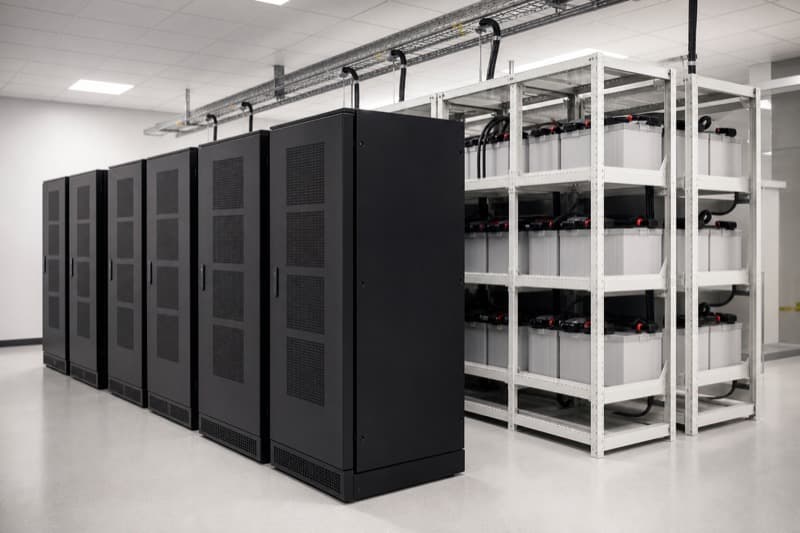
A DC power system pairs rectifier modules with a battery string to feed 24V, 48V, or 110/220V DC loads directly, telecom racks, SCADA panels, and substation switchgear tripping supplies, without an inverter stage. NLS sources DC power plants with N+1 rectifier redundancy for Saudi substation, telecom, and industrial control room installations.
Not every critical load needs an AC waveform. Telecom and network racks, SCADA and PLC control panels, and the protection relays and circuit breaker trip coils inside a substation all run natively on DC, at voltages like 24V and 48V for electronics racks or 110V and 220V for substation protection and control circuits. A DC power system feeds these loads directly, using rectifier modules to convert incoming AC to the required DC voltage and a battery string to hold that voltage up through any interruption, with no inverter stage in between since the load never needed AC in the first place.
Rectifier modules are typically arranged N+1, similar in concept to a modular UPS, so a single module failure doesn't interrupt the DC bus and a failed module can be swapped without powering down the system. Battery autonomy is sized to the application rather than to a fixed rule: a telecom site might carry one to several hours of runtime against a generator start, while a substation battery bank supporting protection and trip circuits is sized against how long it needs to hold circuit breakers operable during a full loss of station AC supply, sometimes eight hours or more depending on the utility's design standard.
This architecture shows up across substations, telecom towers, and industrial control rooms as a distinct system from the facility's UPS, serving loads that were designed for DC from the start rather than AC loads that happen to need ride-through power.
NLS sources DC power plants, rectifier modules, and matched battery strings sized to the bus voltage, rectifier redundancy, and autonomy a project's control and protection system specifies, for Saudi substation, telecom, and industrial control room installations.
Specifications
- ✓Architecture: rectifier modules plus battery string feeding DC loads directly, no inverter stage
- ✓Typical voltages: 24V and 48V for electronics/telecom racks, 110V and 220V for substation protection circuits
- ✓Redundancy: N+1 rectifier modules, hot-swappable without powering down the DC bus
- ✓Battery autonomy: sized to application, from hours for telecom sites to 8+ hours for substation protection banks
- ✓Standards referenced: IEC 60896 series for the stationary battery string within the plant
- ✓Application: telecom and network racks, SCADA/PLC panels, substation switchgear tripping and protection supplies
Frequently Asked Questions
Why do substations and telecom sites use DC power systems instead of a UPS?+
Because the loads, protection relays, breaker trip coils, SCADA panels, run natively on DC. A DC power system skips the inverter stage a UPS would add, feeding rectified and battery-backed DC straight to the load.
How is DC power system redundancy achieved?+
Through N+1 rectifier modules feeding the same DC bus, so one module failing doesn't interrupt the load, and the failed module can be replaced live, similar in concept to a modular UPS but with a purely DC output.
Who supplies DC power systems for Saudi substation and telecom projects?+
NLS sources DC power plants, rectifier modules, and matched battery strings sized to the bus voltage, redundancy, and autonomy a project's control and protection system specifies.
Who supplies DC Power Systems in Saudi Arabia?+
NLS Power (Northlane Solutions Company) supplies DC Power Systems across Saudi Arabia, including Riyadh, Jeddah, Dammam and Jubail. Send your specification and quantities to info@nlspower.com or info@northlanesolution.com for a quotation.