
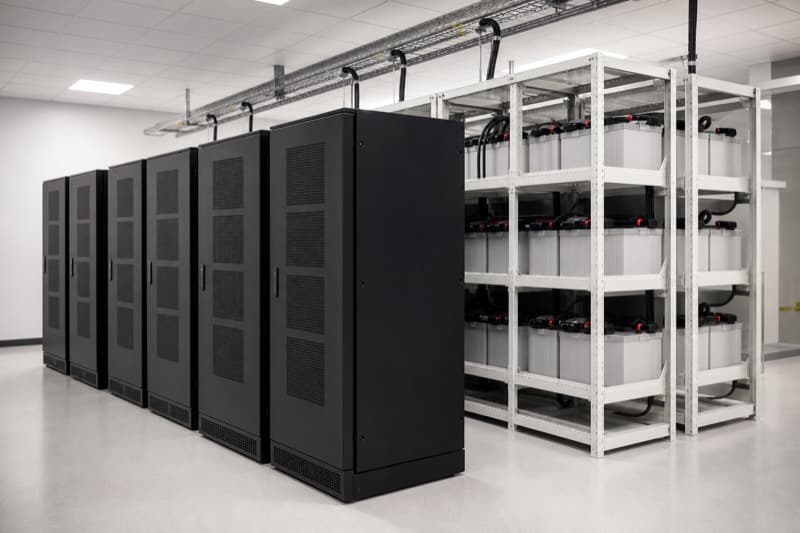
Industrial Inverters
An industrial inverter converts DC to AC for sustained duty, motor drives, process control loads, and battery or solar-tied backup, as distinct from a UPS's short-duration ride-through role. NLS sources industrial inverters built to IEC 62109 or IEC 61800 series requirements depending on the application, as a supply capability across DC-to-AC conversion needs in Saudi industrial and infrastructure projects.
A UPS is built to bridge a short outage, seconds to a few hours on battery, before utility power returns or a generator picks up the load. An industrial inverter serves a different role: continuous DC-to-AC conversion for a sustained duty cycle, feeding a motor drive, a process control system, or an AC load running off a battery bank or solar array as its primary source rather than as backup.
Sizing and protection requirements shift with the application. An inverter feeding a variable frequency drive ahead of a motor sits within the scope of the IEC 61800 series covering adjustable speed electrical power drive systems, with attention to the output waveform quality the motor and its cabling can tolerate. An inverter tied to a battery-and-solar system falls under IEC 62109, which covers the safety requirements for power converters used in photovoltaic power systems, addressing islanding protection, insulation, and grid interaction where the installation connects to the utility.
This is a supply capability rather than a track record NLS is claiming past delivery on: industrial inverters sit alongside categories like solar-tied storage where NLS sources equipment to a project's specification without presenting it as an area of prior installed history. What NLS brings is the sourcing and technical documentation process, matching inverter rating, waveform quality, and the applicable IEC standard to the load it will actually drive.
NLS sources industrial inverters sized to the DC input voltage, AC output requirement, and application standard a project specifies, across Saudi industrial and infrastructure projects needing sustained DC-to-AC conversion.
Specifications
- ✓Function: continuous DC-to-AC conversion for sustained duty, distinct from a UPS's short-duration backup role
- ✓Applications: variable frequency drives, process control loads, battery or solar-tied AC supply
- ✓Standards referenced: IEC 61800 series for drive-connected inverters, IEC 62109 for PV-connected power converters
- ✓Output quality: waveform and harmonic performance matched to the connected motor or load type
- ✓Positioning: a supply capability, not a claimed installed track record
- ✓Sizing: matched to DC input voltage, AC output requirement, and applicable IEC standard per project
Frequently Asked Questions
How is an industrial inverter different from a UPS?+
A UPS bridges a short outage on battery before utility or a generator takes over. An industrial inverter runs continuous DC-to-AC conversion as the primary supply for a motor drive, process load, or battery/solar-tied system.
What standard applies to an inverter feeding a variable frequency drive?+
The IEC 61800 series covers adjustable speed electrical power drive systems, addressing the output waveform quality the connected motor and its cabling need to tolerate.
Who supplies industrial inverters in Saudi Arabia?+
NLS sources industrial inverters sized to the DC input voltage, AC output requirement, and applicable IEC standard a project specifies, as a supply capability across Saudi industrial and infrastructure projects.
Related products
Online Double-Conversion UPS
An online double-conversion UPS rectifies incoming AC to DC and inverts it back to AC continuously, so the output is fully regenerated and isolated from input sags, surges, and frequency drift, with zero transfer time to battery. NLS sources double-conversion UPS units classified VFI under IEC 62040-3 for Saudi hospital essential branches and data centre loads.
Modular UPS Systems
A modular UPS builds capacity from hot-swappable power modules, typically 25-100kW blocks, inside one frame, so N+1 redundancy comes from adding one extra module rather than a second full UPS, and a failed module gets replaced live without dropping the load. NLS sources modular UPS platforms for Saudi data centre N+1 and phased-growth deployments.
Industrial UPS
An industrial UPS is a ruggedized double-conversion unit built for plant environments: wider input voltage tolerance, conformal-coated boards, and higher-rated enclosures for dust and humidity. It protects PLC, DCS, and instrumentation loads where a momentary outage can trip an entire production line. NLS sources industrial UPS units for Saudi process plant and industrial facility power backup.
UPS Battery Banks
A UPS battery bank is a string of VRLA batteries sized to the UPS DC bus voltage, rated for a defined design life at a 20-25°C reference temperature. Every 8-10°C above that reference roughly halves service life, so battery room cooling matters in Saudi ambient conditions. NLS sources VRLA battery strings sized to project autonomy requirements.
Lithium UPS Batteries
Lithium (LFP) UPS battery cabinets replace VRLA strings with roughly 60-70% less footprint and weight for the same runtime, wider ambient tolerance, and thousands more charge cycles over their service life. Each cabinet carries its own battery management system reporting cell health. NLS sources LFP battery cabinets built to IEC 62619 for Saudi hospital and data centre UPS installations.
Battery Monitoring Systems
A battery monitoring system tracks per-string or per-cell voltage, internal resistance, and temperature on a UPS battery bank, flagging a weakening cell before a runtime test would reveal it. This matters in Saudi battery rooms, where uneven heat exposure ages cells within the same string at different rates. NLS sources monitoring platforms for VRLA and lithium UPS banks.