Online Double-Conversion UPS
An online double-conversion UPS rectifies incoming AC to DC and inverts it back to AC continuously, so the output is fully regenerated and isolated from input sags, surges, and frequency drift, with zero transfer time to battery. NLS sources double-conversion UPS units classified VFI under IEC 62040-3 for Saudi hospital essential branches and data centre loads.
A double-conversion (online) UPS runs incoming utility power through a rectifier to DC, then through an inverter back to AC, all the time, including when the input is perfectly healthy. That means the load never actually sees raw utility power; it sees whatever the inverter produces, so a voltage sag, a surge, a frequency deviation, or harmonic distortion on the input side never reaches the connected equipment. If utility power fails outright, the battery simply takes over the DC bus feeding the same inverter, with no switch to throw and no transfer time, unlike a standby or line-interactive UPS that has to detect a fault and switch over.
IEC 62040-3 classifies this behavior as VFI, voltage and frequency independent, the highest of the three UPS output-classification tiers because the output depends on neither the voltage nor frequency of the input. Efficiency runs a little lower than a line-interactive design, typically in the 94-96% range for a modern double-conversion unit, a tradeoff accepted because the load can't tolerate even the few milliseconds a lower-tier UPS takes to transfer.
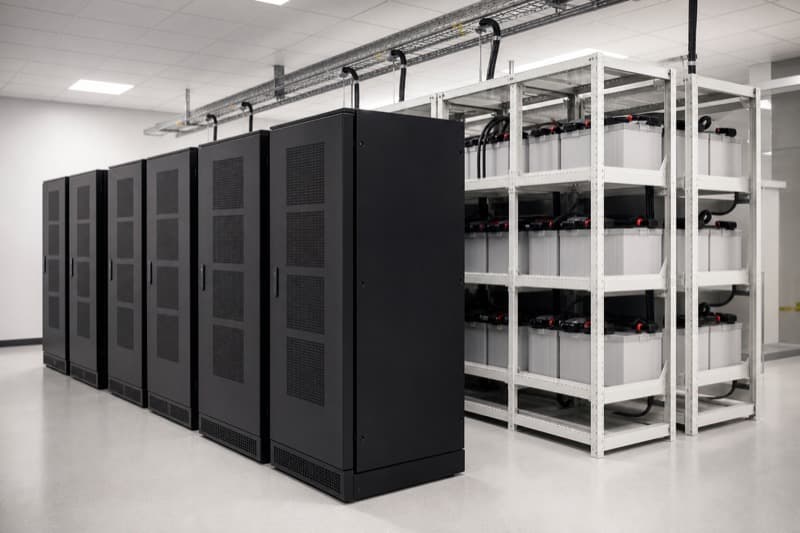
This is the class specified for loads where any interruption at all is unacceptable: hospital essential electrical system branches feeding life-safety and critical equipment, and data centre IT racks where a transfer glitch can reboot a server. Units run from roughly 10kVA for a single equipment room up to 800kVA and beyond per frame, with multiple units paralleled for larger capacity or for N+1 redundancy.
NLS sources online double-conversion UPS units sized to the load schedule and redundancy level a project specifies, quoting in USD against the kVA rating, battery autonomy required, and whether the installation calls for a single unit or a parallel-redundant configuration.
Specifications
- ✓Classification: VFI (voltage and frequency independent) per IEC 62040-3, the highest UPS output tier
- ✓Topology: continuous double conversion, AC-DC-AC, zero transfer time to battery on utility loss
- ✓Efficiency: typically 94-96% for modern double-conversion units
- ✓Ratings: roughly 10kVA to 800kVA+ per frame, paralleled for larger capacity or N+1 redundancy
- ✓Output: fully regenerated, isolated from input sags, surges, frequency deviation, and harmonics
- ✓Application: hospital essential electrical branches and data centre IT loads requiring zero-interruption power
Frequently Asked Questions
What does VFI classification mean for a UPS?+
VFI, voltage and frequency independent, is the top tier under IEC 62040-3. It means the UPS output stays stable regardless of voltage sags, surges, or frequency drift on the utility input, because the load runs off the inverter at all times.
Why choose a double-conversion UPS over a line-interactive one?+
A double-conversion UPS has zero transfer time because the load always runs off the inverter, never off raw utility. A line-interactive UPS has to detect a fault and switch, which takes a few milliseconds, acceptable for general IT loads but not for hospital life-safety branches.
Who supplies online double-conversion UPS systems in Saudi Arabia?+
NLS sources double-conversion UPS units sized to the load schedule and redundancy level a project specifies, quoting in USD against the kVA rating and required battery autonomy for hospital and data centre projects.
Who supplies Online Double-Conversion UPS in Saudi Arabia?+
NLS Power (Northlane Solutions Company) supplies Online Double-Conversion UPS across Saudi Arabia, including Riyadh, Jeddah, Dammam and Jubail. Send your specification and quantities to info@nlspower.com or info@northlanesolution.com for a quotation.