
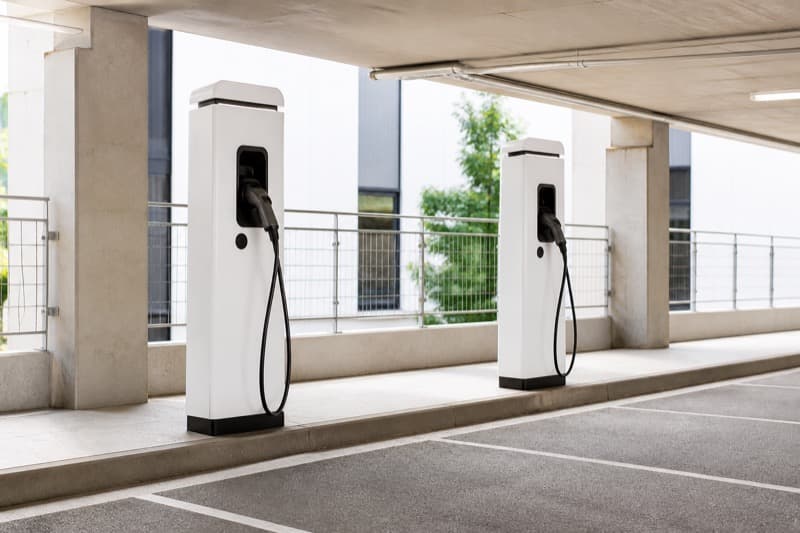
EV Charger Cable Assemblies
EV charger cable assemblies are the tethered charging cable and connector, IEC 62196 Type 2 for AC or CCS2 for DC, engineered for the flex cycles, current rating and outdoor exposure a public charge point sees over years of daily use. NLS Power sources and supplies replacement and OEM cable assemblies for AC and DC chargers installed across Saudi Arabia.
A charger cable assembly is the connector, cable and strain relief that runs from a charging unit to the vehicle, and it takes more physical abuse over its service life than almost any other part of the installation. A public or commercial charge point cable gets coiled, dropped, run over and left in direct sun on a routine basis, so the assembly needs to hold up to a rated number of mating cycles, a specific bend radius and flex fatigue tolerance, and, in Saudi conditions specifically, UV and thermal resistance well beyond what a residential cable would need.
AC cable assemblies use the IEC 62196 Type 2 connector and typically run 5m to 7.5m, sized to reach the parking envelope a bay is designed around without excess slack that becomes a trip hazard or a wear point where it drags on the ground. DC cable assemblies use CCS2 and carry a heavier, often liquid-cooled cable for the higher current a fast or ultra-fast charger delivers, since a passively cooled cable at that current rating would need to be too thick and heavy for a driver to handle comfortably.
Cable assemblies are also one of the more common wear items on a charging network. Connector pins and latching mechanisms take repeated mechanical cycling, and a damaged cable is usually what takes a charger out of service long before the power electronics inside the unit fail, which makes assembly quality and connector durability a real factor in total cost of ownership over a multi-year deployment, alongside the upfront charger price.
NLS Power sources and supplies both AC Type 2 and DC CCS2 cable assemblies, as OEM components for new installations and as replacement parts for chargers already in service across Saudi Arabia.
Specifications
- ✓AC connector: IEC 62196 Type 2, typically 5m to 7.5m tethered cable length
- ✓DC connector: CCS2, liquid-cooled cable option for high-current fast and ultra-fast charging
- ✓Durability: rated mating cycle count, bend radius and flex fatigue tolerance for daily public use
- ✓Environmental resistance: UV-stabilized outer jacket and thermal rating suited to Saudi outdoor exposure
- ✓Strain relief: reinforced connector-to-cable transition to resist the pulling and dropping cycle of daily use
- ✓Availability: OEM assemblies for new installs and replacement assemblies for chargers already in service
Frequently Asked Questions
Why do EV charger cables wear out faster than the charger itself?+
The cable and connector take direct mechanical abuse, coiling, dropping, being run over, on every single charging session, while the power electronics inside the unit sit protected in an enclosure. A damaged cable is usually what puts a public charger out of service long before its internal components fail.
What's the difference between AC and DC charger cable assemblies?+
AC cables use an IEC 62196 Type 2 connector and a lighter cable since they carry lower current. DC fast charging cables use CCS2 and are often liquid-cooled internally, because passively cooling a cable rated for DC fast-charging current would make it too thick and heavy to handle comfortably.
Can a damaged EV charger cable be replaced without replacing the whole unit?+
In most cases yes. The cable assembly is a serviceable component, and replacing it is far cheaper and faster than replacing the charger, provided the replacement assembly matches the original connector type and current rating.
Who supplies EV Charger Cable Assemblies in Saudi Arabia?+
NLS Power (Northlane Solutions Company) supplies EV Charger Cable Assemblies across Saudi Arabia, including Riyadh, Jeddah, Dammam and Jubail. Send your specification and quantities to info@nlspower.com or info@northlanesolution.com for a quotation.