
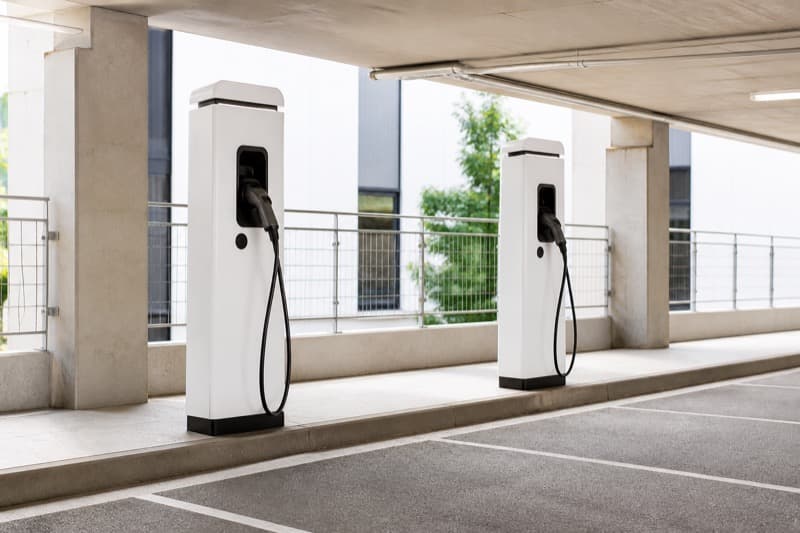
EV Charging Load Management
EV charging load management shares a site's fixed electrical supply dynamically across whichever chargers are plugged in, rather than sizing for every charger at full power together. NLS Power sources and supplies load management controllers for wallbox and DC installs across Saudi Arabia, usually the difference between fitting EV charging into an existing supply and paying for an SEC upgrade.
Load management is the control layer that sits between a site's electrical supply and its EV chargers, and it's what makes multi-charger installations financially realistic. Without it, a site has to size its electrical supply for every connected charger running at full rated power at the same time, a scenario that almost never happens in practice but that a naive design has to plan for anyway. With it, a controller reads the site's actual available capacity in real time and allocates power dynamically across whichever chargers are in use, throttling individual units down as more vehicles plug in rather than tripping a breaker.
Two approaches cover most installations. Static load management splits a fixed power budget evenly, or by priority tier, across a known number of charge points, simpler to design and commission but less efficient when usage is uneven. Dynamic load management monitors the building's overall electrical demand in real time and gives EV charging whatever headroom is left after the building's other loads are served, which extracts more usable charging capacity from the same supply but needs integration with the site's main metering or building management system.
For Saudi projects this is usually the deciding factor in whether EV charging fits within an existing supply or forces an SEC capacity upgrade, which is a materially larger cost and a much longer lead time than the charging equipment itself. Malls, hotels, compounds and office towers retrofitting charging into a building that predates any EV plan are the clearest case where load management pays for itself against the alternative of a supply upgrade.
NLS Power sources and supplies load management controllers and the OCPP-based back-end software that coordinates them, sized to the number of charge points and the site's actual available electrical capacity.
Specifications
- ✓Static load management: fixed or priority-based power split across a known number of charge points
- ✓Dynamic load management: real-time allocation based on the site's actual available capacity, integrated with building metering
- ✓Communication: OCPP-based coordination between the controller and individual charge points
- ✓Scalability: designed to add charge points over time without re-engineering the electrical supply
- ✓Typical benefit: avoids or defers an SEC supply capacity upgrade on retrofit EV charging projects
- ✓Typical use: mall, hotel, compound and office car parks with multiple charge points on one supply
Frequently Asked Questions
What does EV charging load management actually do?+
It monitors how much electrical capacity a site actually has available and allocates it dynamically across whichever chargers are in use, instead of requiring the supply to be sized for every charger running at full power at once. That's what makes adding several chargers to one building supply realistic.
What's the difference between static and dynamic load management?+
Static load management splits a fixed power budget evenly or by priority across a known number of charge points, simpler but less efficient. Dynamic load management reads the building's real-time electrical demand and gives EV charging whatever capacity is left over, extracting more usable charging power from the same supply.
Can load management avoid the need for an SEC supply upgrade?+
In many retrofit cases, yes. Load management is usually the deciding factor between fitting multiple EV chargers into an existing building supply or triggering a capacity upgrade, which carries a materially higher cost and longer lead time than the charging equipment itself.
Who supplies EV Charging Load Management in Saudi Arabia?+
NLS Power (Northlane Solutions Company) supplies EV Charging Load Management across Saudi Arabia, including Riyadh, Jeddah, Dammam and Jubail. Send your specification and quantities to info@nlspower.com or info@northlanesolution.com for a quotation.