
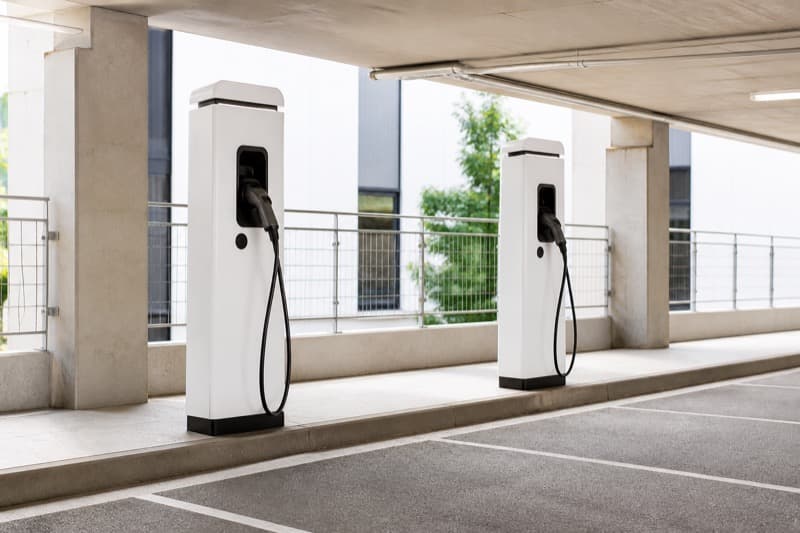
DC Fast Chargers
DC fast chargers convert AC to DC inside the unit and feed the vehicle battery directly through a CCS2 connector, cutting charge time to 20 to 60 minutes instead of hours. NLS Power sources and supplies DC fast chargers from 30kW to 180kW for retail, highway and fleet-turnaround sites across Saudi Arabia, sized to the site's available electrical supply.
A DC fast charger does the AC-to-DC conversion inside the charging unit itself rather than relying on the vehicle's onboard charger, which is what lets it push much higher power directly into the battery through a CCS2 connector (or CHAdeMO on older vehicle models, though CCS2 is now the practical standard in this market). Typical ratings run from 30kW, enough for a meaningful top-up in 30 to 45 minutes, up to 180kW units that can take a compatible vehicle from low charge to a usable range in well under an hour.
This speed comes at a cost the site design has to absorb. A single 150kW charger draws roughly the same demand as a mid-size commercial building, so a DC fast charger installation is much more of an electrical supply exercise than an AC wallbox job: it usually needs its own transformer or a dedicated feed sized specifically for the charging load, plus a switchgear and protection scheme rated for the fault current a DC system introduces. Retail parking, highway rest stops and fleet depots turning vehicles around between routes are the locations where the short dwell time justifies this level of infrastructure.
Site planning has to account for simultaneous use. A bank of DC fast chargers rarely runs at full rated power on every connector at once, so dynamic load sharing between units, and coordination with the site's overall demand profile, usually determines the realistic number of chargers a given supply capacity can support without an SEC upgrade.
NLS Power sources and supplies DC fast chargers across the 30kW to 180kW range for retail, highway and fleet-turnaround sites in Saudi Arabia, specified against the connector standard, power rating and grid connection point a project's electrical design confirms.
Specifications
- ✓Connector: CCS2 as the market default, CHAdeMO available for legacy vehicle compatibility
- ✓Power range: 30kW to 180kW per unit, DC output direct to the vehicle battery
- ✓Charge time: typically 20 to 60 minutes for a meaningful state-of-charge increase, model dependent
- ✓Electrical supply: usually needs a dedicated transformer feed or supply upgrade sized to the charging load
- ✓Load sharing: dynamic power distribution across multiple connectors on one unit or one supply point
- ✓Connectivity: OCPP back-end integration for remote monitoring, payment and fault reporting
Frequently Asked Questions
How long does it take to charge an EV with a DC fast charger?+
Most DC fast chargers add a meaningful state of charge in 20 to 60 minutes, depending on the charger's power rating, the vehicle's maximum DC input, and how full the battery already is; charging slows down considerably above roughly 80 percent regardless of charger power.
What electrical supply does a DC fast charger site need?+
A single high-power DC charger can draw as much demand as a mid-size building, so most installations need a dedicated transformer feed sized specifically for the charging load rather than a tap off the existing site supply. This is usually the biggest line item in a DC fast charging project, ahead of the charger hardware itself.
Who supplies DC fast EV chargers in Saudi Arabia?+
NLS Power sources and supplies CCS2 DC fast chargers from 30kW to 180kW for retail, highway and fleet sites across Saudi Arabia, specified to match the site's available electrical supply and the connector standard a project calls for.
Who supplies DC Fast Chargers in Saudi Arabia?+
NLS Power (Northlane Solutions Company) supplies DC Fast Chargers across Saudi Arabia, including Riyadh, Jeddah, Dammam and Jubail. Send your specification and quantities to info@nlspower.com or info@northlanesolution.com for a quotation.