
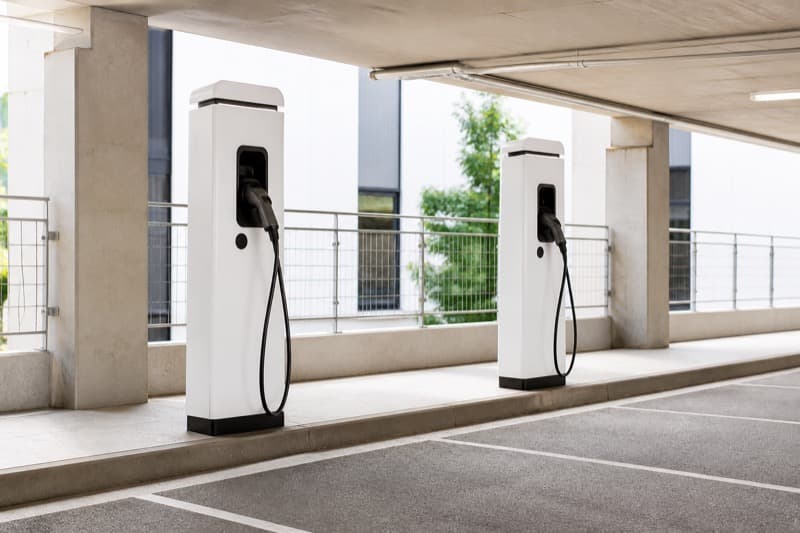
Solar EV Charging
Solar EV charging pairs a rooftop or carport PV array with charge points, either offsetting grid draw during daylight hours or, with battery storage added, extending that offset into the evening. NLS Power sources and supplies solar-integrated EV charging systems for Saudi Arabia's high solar-irradiance climate, sized against the site's parking footprint and typical charging demand profile.
Solar EV charging connects a photovoltaic array, typically carport-mounted over the parking bays themselves or rooftop on an adjacent building, to the site's EV charging load, either through direct DC coupling into a DC charger, through the site's AC distribution feeding standard AC or DC chargers, or through a hybrid arrangement with battery storage that shifts solar generation into the hours when vehicles are actually charging. Saudi Arabia's solar irradiance is among the highest in the world, which makes the generation side of this equation unusually favorable, but the design challenge is almost always about timing rather than generation capacity.
Daytime-heavy charging profiles, office and workplace parking where vehicles arrive in the morning and sit through the working day, line up well with solar generation and can offset a meaningful share of charging load directly from the array without storage. Evening and overnight-heavy profiles, residential compounds and fleet depots charging after hours, need battery storage to shift the solar energy generated during the day into the hours when it's actually used, which adds cost and complexity but avoids exporting surplus generation back to the grid at a time when net metering terms may not favor it.
Carport-mounted PV has the added benefit of shading the parking bays themselves, which matters in Saudi ambient heat both for vehicle and battery thermal comfort and for the charging equipment's own operating temperature. Structural design for a carport array needs to account for the same wind and dust loading considerations as any other Saudi rooftop PV installation, plus the added weight and access requirements of chargers mounted on or near the support structure.
NLS Power sources and supplies solar-integrated EV charging systems, coordinating the PV array, optional battery storage and charging hardware around the site's actual usage pattern rather than treating solar as a separate add-on.
Specifications
- ✓Configuration: carport or rooftop PV array feeding site AC distribution or coupled directly to DC chargers
- ✓Storage option: battery storage shifts daytime solar generation into evening or overnight charging demand
- ✓Best fit: daytime-heavy charging profiles (office, workplace parking) offset directly from PV without storage
- ✓Structural: carport array sized for Saudi wind and dust loading, plus mounted-charger weight and access
- ✓Thermal benefit: carport shading reduces ambient heat load on parked vehicles and charging equipment
- ✓Typical use: office and workplace parking, residential compounds and fleet depots pairing generation with charging
Frequently Asked Questions
Does solar EV charging need battery storage to work?+
Not always. Daytime-heavy charging profiles, like office parking where vehicles arrive in the morning and stay through the day, can offset a meaningful share of load directly from the PV array. Evening or overnight charging profiles need battery storage to shift that daytime generation into the hours it's actually used.
Why is carport-mounted solar a good fit for EV charging in Saudi Arabia?+
It puts the PV array directly over the parking bays, generating power at the point of use while also shading vehicles and charging equipment from direct sun, which matters for both occupant comfort and equipment operating temperature in Saudi ambient heat.
Who supplies solar-integrated EV charging systems in Saudi Arabia?+
NLS Power sources and supplies carport or rooftop PV arrays paired with AC or DC charging hardware and, where the usage profile calls for it, battery storage, sized against the site's actual parking footprint and charging demand pattern.
Related products
AC Wallbox Chargers
AC wallbox chargers deliver 7 to 22kW of alternating current through an IEC 62196 Type 2 connector, sized for vehicles that sit parked for hours rather than minutes. NLS Power sources and supplies AC wallboxes for offices, hotels, residential compounds and long-stay parking across Saudi Arabia, specified with the load management a site's incoming supply can actually support.
DC Fast Chargers
DC fast chargers convert AC to DC inside the unit and feed the vehicle battery directly through a CCS2 connector, cutting charge time to 20 to 60 minutes instead of hours. NLS Power sources and supplies DC fast chargers from 30kW to 180kW for retail, highway and fleet-turnaround sites across Saudi Arabia, sized to the site's available electrical supply.
Ultra-Fast Charging Stations
Ultra-fast charging stations push 180kW to 400kW per connector through a CCS2 interface, cutting a meaningful charge to 10 to 20 minutes for compatible vehicles. NLS Power sources and supplies ultra-fast charging hubs for highway corridors and high-throughput commercial sites in Saudi Arabia, where the grid connection sets the real project cost more than the charger itself.
EV Charging Load Management
EV charging load management shares a site's fixed electrical supply dynamically across whichever chargers are plugged in, rather than sizing for every charger at full power together. NLS Power sources and supplies load management controllers for wallbox and DC installs across Saudi Arabia, usually the difference between fitting EV charging into an existing supply and paying for an SEC upgrade.
EV Charging Management Software
EV charging management software runs on the OCPP protocol to monitor, control and bill charge points remotely, from a single wallbox to a multi-site network, independent of hardware brand. NLS Power sources and supplies OCPP-compliant back-end platforms alongside its charging hardware for Saudi projects that need remote monitoring, access control or usage billing.
EV Charger Cable Assemblies
EV charger cable assemblies are the tethered charging cable and connector, IEC 62196 Type 2 for AC or CCS2 for DC, engineered for the flex cycles, current rating and outdoor exposure a public charge point sees over years of daily use. NLS Power sources and supplies replacement and OEM cable assemblies for AC and DC chargers installed across Saudi Arabia.
Guides
What Does EV Charger Installation Cost in Saudi Arabia? Market Ranges and Cost Drivers
What drives EV charger installation cost in Saudi Arabia: charger type and power rating, civil and cable works, distance to the electrical board, spare supply capacity, load management versus a supply upgrade, and the OCPP back end.
Solar Plus Battery Storage Economics for Saudi Commercial Facilities
What actually drives solar plus battery storage payback for Saudi commercial facilities: tariff structure, self-consumption share, cell temperature derating, soiling losses, and when storage earns its cost.
Electric Vehicle Cable Assemblies: A B2B Buyer's Guide
Understanding electric vehicle cable assemblies is key for EV infrastructure in Saudi Arabia. Discover types, standards, and selection criteria from NLS Power.