
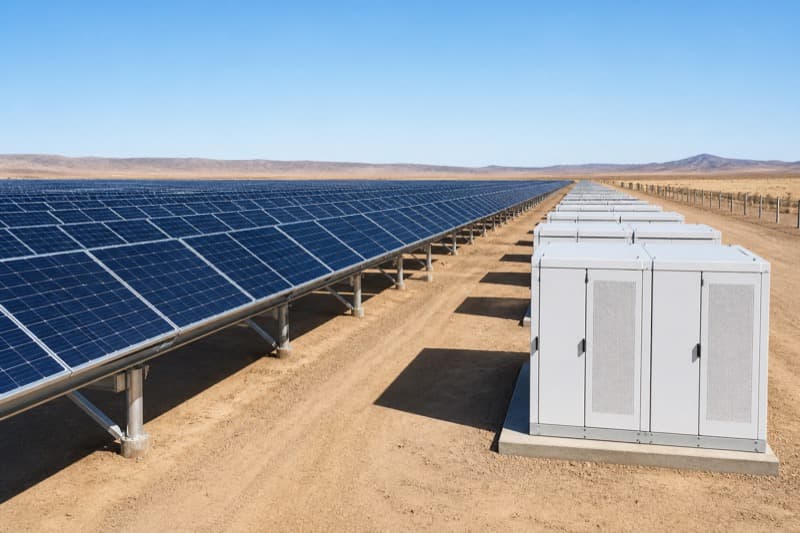
Battery Energy Storage Systems
Battery energy storage systems (BESS) store DC electricity, typically from solar generation or off-peak grid supply, for later use during peak demand, an outage, or off-grid operation. NLS sources lithium iron phosphate (LFP) battery systems for their stability and cycle life in Saudi ambient conditions, sized from residential backup units to commercial and utility-scale containerized systems.
A battery energy storage system pairs a battery bank with a battery management system (BMS) that monitors individual cell voltage, temperature, and state of charge, and a power conversion system (either a hybrid inverter for smaller systems or a dedicated battery inverter for larger ones) that moves power in and out of the bank. The role a BESS plays depends on what it's paired with: behind a solar array, it shifts self-consumption from daylight hours into the evening; on a straight grid connection, it can arbitrage time-of-use tariff differences or cap peak demand charges; on a critical facility, it provides ride-through power during the transfer time before a backup generator starts, or as the sole backup source for shorter outages.
Lithium iron phosphate (LFP) chemistry has become the standard choice for stationary storage over other lithium-ion chemistries like NMC, mainly because of thermal stability: LFP cells have a higher thermal runaway threshold and don't release oxygen readily during a fault, which matters directly in Saudi conditions where the battery enclosure itself sits in high ambient temperature and any thermal margin the chemistry offers reduces the cooling burden the enclosure's thermal management system carries. LFP also holds up better over repeated deep cycling, typically rated for several thousand cycles to 80% of original capacity, which suits daily solar-shifting duty where the battery cycles once or more every single day of its service life, unlike an emergency-only backup battery that might cycle only a handful of times a year.
Battery capacity is specified in both kWh (total energy storage) and kW (power output rating), and the ratio between the two, the C-rate, determines how fast the battery can discharge its stored energy; a system built for a short high-power backup need has a different C-rate requirement than one built to shift solar energy evenly across a long evening period. Enclosure thermal management, whether passive ventilation, active cooling, or a climate-controlled container, needs sizing against the site's actual ambient and the battery chemistry's operating temperature window, since running a lithium battery outside its rated temperature range shortens both performance and service life.
Sourcing runs from a use case and target capacity. A project team specifies the application (solar shifting, backup, peak shaving, or off-grid), target kWh and kW figures, and site ambient conditions, and NLS returns system selection and a priced quote in USD, with lead time set by capacity class and whether the system is a standard cabinet unit or a custom containerized installation.
Specifications
- ✓Chemistry: lithium iron phosphate (LFP), selected for thermal stability and deep-cycle life over NMC alternatives
- ✓Includes battery management system (BMS): cell-level voltage, temperature, and state-of-charge monitoring
- ✓Capacity specified in kWh (energy) and kW (power); C-rate ratio sized to the discharge duration required
- ✓Cycle life typically rated to several thousand cycles at 80% capacity retention for daily solar-shifting duty
- ✓Enclosure thermal management (passive, active, or climate-controlled container) sized to site ambient
- ✓Applications: solar self-consumption shifting, peak shaving, backup power, and off-grid operation
Frequently Asked Questions
Who supplies battery energy storage systems in Saudi Arabia?+
NLS sources LFP battery storage systems from residential backup units to commercial and utility-scale containerized systems, sized against the target kWh/kW figures and ambient conditions for Saudi solar and backup projects.
Why is LFP the standard battery chemistry for stationary storage in Saudi Arabia?+
LFP cells have a higher thermal runaway threshold than other lithium-ion chemistries, which matters in a hot ambient environment, and they hold up better over the thousands of daily charge-discharge cycles a solar-shifting battery goes through over its service life.
What lead time should I expect for a BESS order in KSA?+
Lead time depends on capacity class and whether the system is a standard cabinet unit or a custom containerized installation. NLS confirms the figure once the use case and target kWh/kW capacity are set.
Who supplies Battery Energy Storage Systems in Saudi Arabia?+
NLS Power (Northlane Solutions Company) supplies Battery Energy Storage Systems across Saudi Arabia, including Riyadh, Jeddah, Dammam and Jubail. Send your specification and quantities to info@nlspower.com or info@northlanesolution.com for a quotation.