
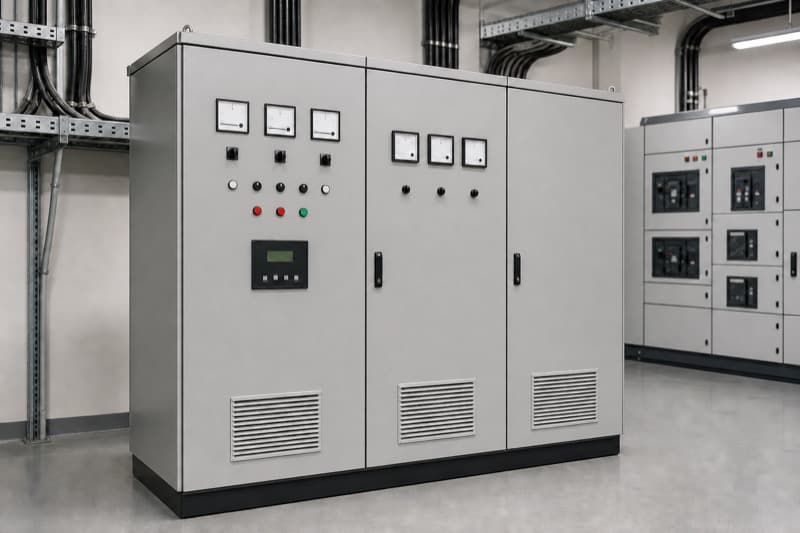
Automatic Voltage Regulators
Automatic voltage regulators (AVRs) hold generator or supply output voltage within a tight tolerance band as load and speed vary, sensing output continuously and adjusting excitation or a tap changer in response. NLS sources AVR units for standalone generators and larger tap-changing regulators for distribution feeders, matched to the voltage regulation class Saudi projects specify.
An automatic voltage regulator is the control loop that keeps a generator's, or a distribution feeder's, output voltage stable as the load it's serving changes, rather than letting output voltage sag under heavy load or rise under light load the way an uncontrolled source would. On a generator, the AVR continuously measures output voltage and adjusts the excitation current fed to the alternator's field winding, increasing excitation to hold voltage up as load increases, and reducing it as load drops, all within a response time fast enough to keep voltage within the regulation band even through a sudden load step, like a large motor starting.
On distribution feeders rather than generators, voltage regulation more commonly uses a tap-changing regulator, either an on-load tap changer that adjusts a transformer's turns ratio while energized, or a step-voltage regulator dedicated to feeder voltage correction, both aimed at the same voltage drop problem that plagues long feeders: voltage at the far end of the line sags as distance and current increase, and a tap changer boosts voltage at the regulation point to compensate, rather than the point-of-load correction a voltage stabilizer applies right at the equipment itself. Which approach fits a given project depends on whether the goal is correcting voltage for a single critical load (a stabilizer) or holding voltage within range across an entire feeder serving multiple downstream loads (a regulator).
Generator AVR performance is specified by voltage regulation percentage, how tightly output voltage is held across the load range, and transient response, how quickly voltage recovers after a sudden load change without an unacceptable dip or overshoot; a poorly performing AVR shows up operationally as lights dimming when a large motor starts, or sensitive electronic equipment tripping on an undervoltage event that a well-tuned AVR would have ridden through. Saudi standby and prime power generator installations, especially those serving hospital or data center loads where a voltage transient has real consequences, specify AVR performance against the generator set's full published transient response curve rather than the steady-state regulation percentage alone.
Sourcing runs from the equipment the AVR serves. For a generator, NLS sources the AVR matched to the alternator model and excitation system it's replacing or being specified into; for a feeder application, a project's electrical consultant specifies the regulation range and tap-changer configuration needed. NLS returns a priced quote in USD with lead time set by whether the unit is a standard generator AVR replacement part or a larger feeder regulator built to a specific voltage class.
Specifications
- ✓Generator AVR performance specified by voltage regulation percentage and transient response curve
- ✓Feeder-level regulation via on-load tap changer or step-voltage regulator for line voltage drop correction
- ✓Matched to specific alternator model and excitation system for generator replacement applications
- ✓Response time sized to ride through sudden load steps (e.g. large motor starting) without unacceptable dip
- ✓Critical-facility generator sets (hospital, data center) specified against full transient response curve
- ✓Standards referenced: applicable IEC/ISO generator excitation and voltage regulation standards
Frequently Asked Questions
Who supplies automatic voltage regulators in Saudi Arabia?+
NLS sources generator AVR units matched to the specific alternator and excitation system, and larger tap-changing regulators for distribution feeders, for Saudi industrial, hospital, and data center projects.
What's the difference between an AVR and a voltage stabilizer?+
An AVR regulates the source itself, a generator's excitation or a feeder's tap changer, controlling voltage for everything downstream. A voltage stabilizer corrects voltage right at a specific piece of equipment, independent of what's happening at the source.
What lead time should I expect for AVR units in KSA?+
Lead time depends on whether the unit is a standard generator AVR replacement part or a larger feeder regulator built to a specific voltage class. NLS confirms the figure once the equipment it serves is specified.
Who supplies Automatic Voltage Regulators in Saudi Arabia?+
NLS Power (Northlane Solutions Company) supplies Automatic Voltage Regulators across Saudi Arabia, including Riyadh, Jeddah, Dammam and Jubail. Send your specification and quantities to info@nlspower.com or info@northlanesolution.com for a quotation.