
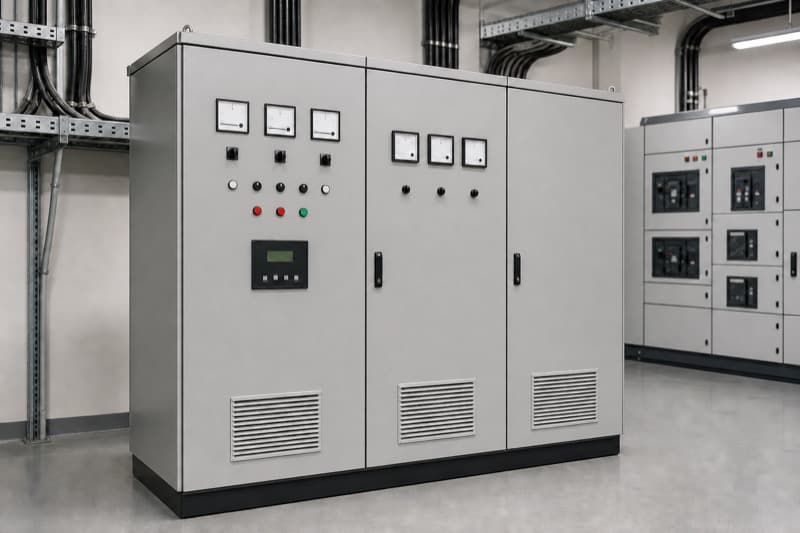
Voltage Stabilizers
Voltage stabilizers correct incoming supply voltage that drifts outside equipment tolerance, holding output within a tight band regardless of input swings. NLS sources servo-controlled and relay-type voltage stabilizers sized for the voltage drop and sag conditions common on long feeders at remote Saudi sites, protecting sensitive equipment on industrial, medical, and commercial installations.
A voltage stabilizer sits between the incoming electrical supply and a load, correcting voltage that arrives outside the range equipment is designed to tolerate before that voltage reaches sensitive machinery, medical equipment, or process control systems. Servo-controlled stabilizers use a motor-driven variable transformer (a variac) to continuously adjust the output ratio, giving smooth, stepless correction but with a response time measured in seconds, which suits steady drift-type voltage variation rather than a sudden transient. Relay-type stabilizers switch between tapped transformer windings using electronic relays, correcting faster than a servo unit but in discrete voltage steps rather than a smooth curve, which suits applications where speed matters more than the last percentage point of correction precision.
Voltage drop on long feeders is a real and common problem on remote Saudi industrial and infrastructure sites, where the distance from a substation or main distribution point to a remote load, a pump station, a labor camp, a communications shelter, can run into kilometers, and cable voltage drop over that distance compounds during peak load periods when current draw is highest. A stabilizer positioned at the load end corrects for this drop, but it's worth flagging that a stabilizer treats the symptom, the resulting low voltage, while the underlying cause, undersized cable or excessive route length, may be worth addressing separately if the same feeder serves other loads that would also benefit from a permanent fix rather than a corrective device downstream.
Stabilizer sizing is set by the load's kVA rating, its power factor, and the maximum voltage correction range the site's actual voltage profile requires, sized with margin above nameplate load to handle motor starting current or other inrush conditions rather than sized exactly to steady-state running load. Three-phase stabilizers commonly include per-phase correction to handle unbalanced loads or unequal voltage drop across the three phases, a common condition on sites with unevenly distributed single-phase loads pulling from a shared three-phase feeder.
Sourcing runs from a load schedule and site voltage measurement. A project team sends connected load in kVA, incoming voltage range actually measured or expected at the installation point, and phase configuration, and NLS returns stabilizer selection, servo or relay type, and a priced quote in USD, with lead time set by capacity and whether the unit is a standard rating or a custom capacity build.
Specifications
- ✓Types: servo-controlled (smooth, stepless correction) or relay-type (faster, stepped correction)
- ✓Sized to connected load kVA with margin for motor starting/inrush current, not steady-state load alone
- ✓Correction range set against the site's actual measured incoming voltage profile
- ✓Per-phase correction available on three-phase units for unbalanced load conditions
- ✓Common application: correcting voltage drop at the end of long feeders on remote sites
- ✓Standards referenced: applicable IEC electrical safety and enclosure protection ratings per project spec
Frequently Asked Questions
Who supplies voltage stabilizers in Saudi Arabia?+
NLS sources servo-controlled and relay-type voltage stabilizers sized against the actual voltage drop conditions at remote Saudi sites, for industrial, medical, and commercial equipment protection.
Why do remote Saudi sites need voltage stabilizers on long feeders?+
Cable voltage drop over long distances to a remote load compounds during peak demand, so voltage arriving at the equipment can fall outside its tolerance range. A stabilizer positioned at the load end corrects this, though the underlying cable sizing may also be worth reviewing.
What lead time should I expect for voltage stabilizers in KSA?+
Lead time depends on capacity and whether the unit matches a standard rating or needs a custom capacity build. NLS confirms the figure once the load schedule and site voltage measurement are set.
Who supplies Voltage Stabilizers in Saudi Arabia?+
NLS Power (Northlane Solutions Company) supplies Voltage Stabilizers across Saudi Arabia, including Riyadh, Jeddah, Dammam and Jubail. Send your specification and quantities to info@nlspower.com or info@northlanesolution.com for a quotation.