
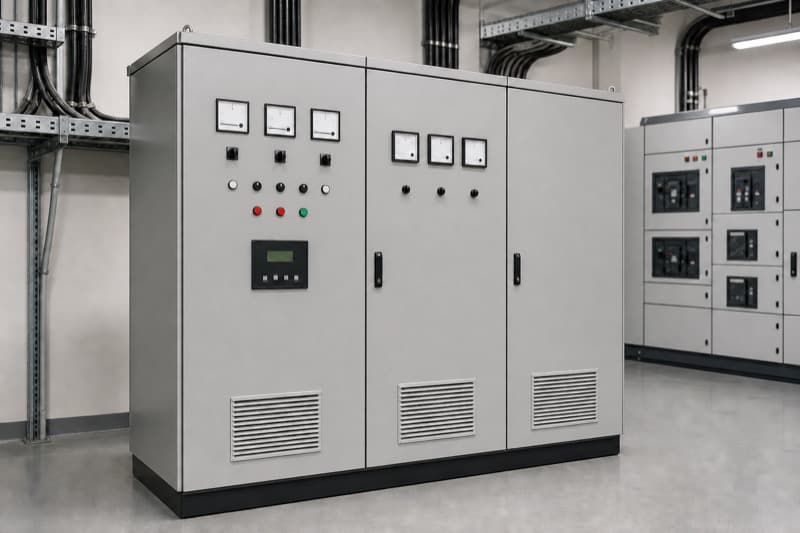
Power Factor Correction Banks
Power factor correction (PFC) banks add capacitor banks in parallel with an inductive load to reduce the reactive power a site draws from the grid, raising power factor toward unity and avoiding SEC low-power-factor penalty charges. NLS sources fixed and automatic PFC banks sized against a site's actual reactive load profile for industrial and commercial installations across Saudi Arabia.
Power factor measures how effectively a site converts the apparent power (kVA) it draws from the grid into actual working power (kW), and inductive loads, motors, transformers, and fluorescent or older-generation lighting ballasts, all pull reactive power (kVAR) that does no useful work but still has to be supplied and carried by the utility's generation, transmission, and distribution equipment. A capacitor bank connected in parallel with the load supplies that reactive power locally instead of drawing it from the grid, which raises the site's measured power factor toward 1.0 (unity) without changing anything about the actual working load being served.
Saudi Electricity Company applies a power factor penalty on commercial and industrial accounts whose measured power factor falls below a specified threshold, which means a site running an uncorrected power factor is paying a real, recurring charge for reactive power it could largely eliminate with a correctly sized capacitor bank, often with a payback period short enough to make the investment straightforward once the actual penalty history is reviewed against the correction cost. Fixed capacitor banks apply a constant correction, sized against the site's average reactive load, and suit a site with a relatively stable load profile across its operating hours. Automatic PFC banks switch capacitor steps in and out using a power factor controller that monitors the site's actual reactive demand in real time, adding or removing capacitance as load varies through the day, which avoids the overcorrection (leading power factor) risk a fixed bank can create when load drops well below its average during low-demand periods.
Sizing a PFC bank starts from the site's actual reactive power demand, ideally measured directly from utility billing data or a power quality survey rather than estimated from nameplate motor ratings alone, since real operating power factor often differs meaningfully from the theoretical value calculated off equipment datasheets. Harmonic content in the site's load also needs checking before specifying plain capacitors, since capacitor banks can resonate with harmonic currents present on a site with significant variable frequency drive or UPS load, in which case a detuned or harmonic filter reactor in series with the capacitors is the correct specification rather than a plain capacitor bank.
Sourcing runs from a load and power factor assessment. A project team sends utility billing data showing current power factor penalty history, or a load schedule with motor and equipment ratings if billing data isn't available, and NLS returns a sized PFC bank, fixed or automatic, and a priced quote in USD, with lead time set by capacity and whether harmonic filtering is required alongside the correction.
Specifications
- ✓Types: fixed capacitor bank or automatic (step-switched) bank with power factor controller
- ✓Sized against actual measured reactive load demand, ideally from utility billing or a power quality survey
- ✓Target correction typically raises power factor toward unity to avoid SEC low-power-factor penalty charges
- ✓Detuned/harmonic filter reactors specified in series where significant VFD or UPS harmonic load is present
- ✓Automatic banks avoid overcorrection (leading power factor) risk during low-demand periods
- ✓Standards referenced: IEC 60831 (capacitor units), IEC 61439 (switchgear/enclosure)
Frequently Asked Questions
Who supplies power factor correction banks in Saudi Arabia?+
NLS sources fixed and automatic PFC banks sized against a site's actual reactive load, with detuned or harmonic filter options where VFD or UPS load is present, for industrial and commercial installations across Saudi Arabia.
Why does SEC charge a power factor penalty?+
A site with low power factor draws more reactive power than necessary, which the utility's generation and distribution equipment still has to supply and carry even though it does no useful work. The penalty reflects that added burden, and a correctly sized capacitor bank largely eliminates it.
What lead time should I expect for a PFC bank in KSA?+
Lead time depends on capacity and whether harmonic filtering is required alongside the basic correction. NLS confirms the figure once the load and power factor assessment are set.
Who supplies Power Factor Correction Banks in Saudi Arabia?+
NLS Power (Northlane Solutions Company) supplies Power Factor Correction Banks across Saudi Arabia, including Riyadh, Jeddah, Dammam and Jubail. Send your specification and quantities to info@nlspower.com or info@northlanesolution.com for a quotation.