
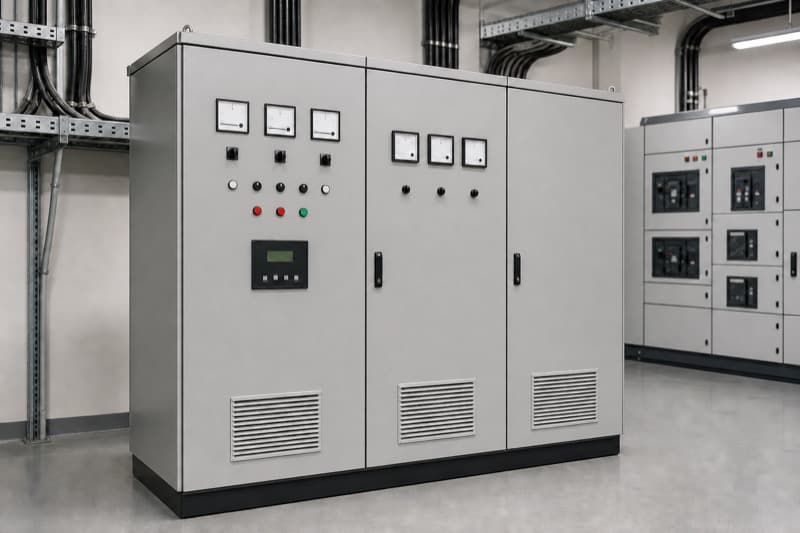
Isolation Transformers
Isolation transformers separate a load electrically from its supply through magnetic coupling with no direct conductive path, blocking common-mode noise and, on medical IT systems, removing the earthed reference fault current would otherwise need to trip a breaker. NLS sources isolation transformers for hospital operating theatre power systems, sensitive electronics, and general noise-isolation applications across Saudi Arabia.
An isolation transformer has a primary and secondary winding coupled only magnetically, with no direct electrical connection between the two, which does two useful things a standard distribution transformer doesn't. First, it blocks common-mode electrical noise, ground loops, and certain types of interference from passing from the supply side to the load side, which matters for sensitive electronic, laboratory, or measurement equipment where electrical noise on the supply degrades accuracy or causes malfunction. Second, and more significantly on medical applications, it creates an ungrounded (floating) secondary system, which changes the fault behavior of the circuit it feeds in a way that specifically matters in patient care areas.
In a standard grounded electrical system, a single fault, a live conductor contacting an earthed surface, creates a fault current path that trips a breaker immediately, disconnecting power. In a hospital operating theatre or critical patient care area, an unplanned power interruption during a procedure carries its own risk, arguably greater than the risk the fault itself posed, which is why medical IT systems built around an isolation transformer are the standard architecture in these areas: a single fault to earth on an isolated secondary doesn't create a fault current large enough to trip anything, since there's no completed circuit back to ground, so power continues uninterrupted while a line isolation monitor alerts staff to the fault condition so it can be corrected at a safe moment rather than forcing an immediate, unplanned power loss mid-procedure.
Saudi hospital projects specify medical IT isolation transformer systems for operating theatres, critical care areas, and other locations classified as requiring this level of continuity, referencing IEC 60364-7-710 (or the equivalent NFPA 99 provisions where a project follows US-style codes) for the specific areas requiring isolated power and the line isolation monitor performance the system needs. Sizing an isolation transformer for this application accounts for the connected medical equipment load plus a margin for future equipment additions, since retrofitting a larger transformer into an operating theatre after the room is built and finished is a materially more disruptive exercise than sizing correctly at initial installation.
Outside medical applications, isolation transformers serve general noise-isolation duty ahead of sensitive laboratory instruments, broadcast or telecom equipment, or process control systems where supply-side electrical noise is a known problem. Sourcing runs from the application and connected load. A project team specifies medical IT system requirements per the relevant code, or the load kVA and noise-isolation requirement for a general application, and NLS returns transformer selection and a priced quote in USD, with lead time set by kVA rating and whether a line isolation monitor and associated panel are included.
Specifications
- ✓Magnetic coupling with no direct conductive path between primary and secondary windings
- ✓Blocks common-mode noise and ground loop interference from supply side to load side
- ✓Medical IT system application: ungrounded secondary prevents a single earth fault from tripping power
- ✓Line isolation monitor included on medical applications to alert staff to a fault condition without interrupting power
- ✓Sized to connected medical equipment load plus margin for future equipment additions
- ✓Standards referenced: IEC 60364-7-710 (medical locations) or NFPA 99 where US-style codes apply
Frequently Asked Questions
Who supplies isolation transformers for hospital operating theatres in Saudi Arabia?+
NLS sources isolation transformers for medical IT power systems, sized to the connected equipment load and including the line isolation monitor these areas require, for hospital projects across Saudi Arabia.
Why do operating theatres use isolated power instead of a standard grounded system?+
A single earth fault on a standard grounded circuit trips a breaker immediately. On an isolated secondary, that same fault doesn't create enough fault current to trip anything, so power continues uninterrupted during a procedure while staff are alerted to correct the fault at a safe moment.
What lead time should I expect for isolation transformers in KSA?+
Lead time depends on kVA rating and whether a line isolation monitor and associated panel are included. NLS confirms the figure once the application and connected load are specified.
Who supplies Isolation Transformers in Saudi Arabia?+
NLS Power (Northlane Solutions Company) supplies Isolation Transformers across Saudi Arabia, including Riyadh, Jeddah, Dammam and Jubail. Send your specification and quantities to info@nlspower.com or info@northlanesolution.com for a quotation.