
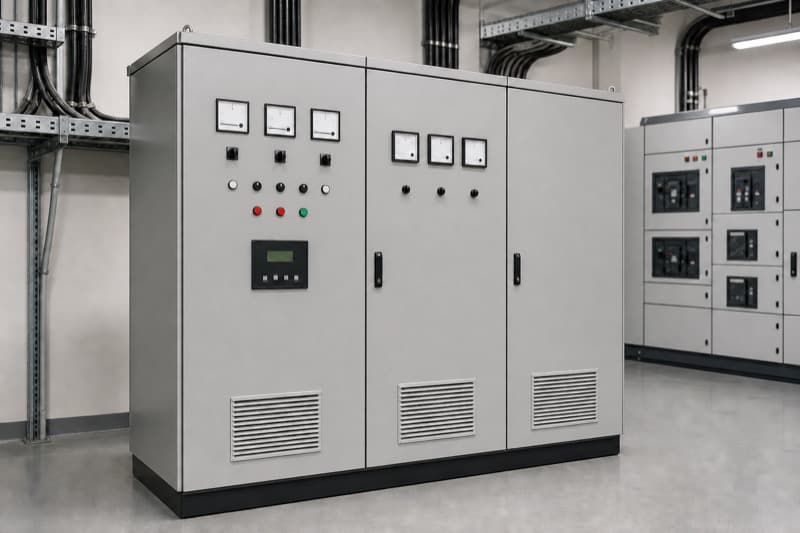
Harmonic Filters
Harmonic filters reduce voltage and current distortion caused by non-linear loads such as variable frequency drives, UPS systems, and LED lighting drivers, bringing a site's harmonic distortion within IEEE 519 limits. NLS sources passive and active harmonic filters sized against a site's actual measured harmonic spectrum for industrial and data centre installations across Saudi Arabia.
Harmonic distortion appears when a load doesn't draw current in a clean sine wave matching the supply voltage, which is exactly what non-linear loads, variable frequency drives, UPS rectifier front ends, LED and fluorescent lighting drivers, and switch-mode power supplies in IT equipment, do as a normal part of how they operate. That distorted current creates voltage distortion elsewhere on the same electrical system, which can cause transformer and cable overheating from harmonic currents that don't contribute useful work but still generate heat, nuisance tripping of protective devices misreading distorted waveforms, and interference with other sensitive equipment sharing the same supply.
IEEE 519 is the reference standard most Saudi projects specify for harmonic limits, setting maximum total harmonic distortion (THD) for both voltage and current at the point of common coupling between a facility and the utility supply, with the specific limit depending on the facility's short-circuit ratio relative to its load. A data center, hospital, or industrial site with a large proportion of non-linear load, heavy UPS, VFD, or IT equipment load relative to total site load, is the type of installation most likely to actually exceed IEEE 519 limits and need active filtering, while a site dominated by simple resistive or motor load rarely has a harmonic problem worth addressing.
Passive harmonic filters use tuned inductor-capacitor circuits to trap specific harmonic frequencies (commonly the 5th, 7th, and 11th harmonics that dominate most VFD and rectifier-based distortion), removing a defined portion of distortion at a fixed cost and no ongoing power consumption, but tuned to specific frequencies rather than the site's full harmonic spectrum. Active harmonic filters use power electronics to measure the actual distorted current in real time and inject a compensating waveform that cancels distortion across a broader frequency range, adapting automatically as the site's load and harmonic profile change through the day, at a higher unit cost than passive filtering but with better performance on sites where the harmonic spectrum doesn't sit neatly at one or two dominant frequencies.
Sourcing runs from an actual harmonic measurement. A project team provides a power quality survey showing the site's measured harmonic spectrum and THD levels, or NLS scopes an assessment against the connected non-linear load if a survey hasn't been done, and NLS returns filter selection, passive or active, and a priced quote in USD, with lead time set by filter type and capacity.
Specifications
- ✓Types: passive (tuned LC, fixed frequencies) or active (real-time compensation, broader spectrum)
- ✓Reference standard: IEEE 519 limits for voltage and current THD at the point of common coupling
- ✓Sized against actual measured harmonic spectrum, ideally from a power quality survey
- ✓Passive filters commonly tuned to dominant 5th, 7th, and 11th harmonics from VFD/rectifier loads
- ✓Active filters adapt automatically to changing load and harmonic profile through the day
- ✓Priority applications: data centers, hospitals, and sites with high VFD/UPS/IT non-linear load share
Frequently Asked Questions
Who supplies harmonic filters in Saudi Arabia?+
NLS sources passive and active harmonic filters sized against a site's actual measured harmonic spectrum, bringing distortion within IEEE 519 limits, for industrial and data centre installations across Saudi Arabia.
Which Saudi facilities are most likely to need harmonic filtering?+
Data centers, hospitals, and industrial sites with a large proportion of non-linear load, heavy UPS, VFD, or IT equipment relative to total site load, are the installations most likely to exceed IEEE 519 harmonic limits and need active or passive filtering.
What lead time should I expect for harmonic filters in KSA?+
Lead time depends on filter type, passive or active, and capacity. NLS confirms the figure once the site's harmonic measurement or non-linear load profile is set.
Who supplies Harmonic Filters in Saudi Arabia?+
NLS Power (Northlane Solutions Company) supplies Harmonic Filters across Saudi Arabia, including Riyadh, Jeddah, Dammam and Jubail. Send your specification and quantities to info@nlspower.com or info@northlanesolution.com for a quotation.